TNPSC Current Affairs July 24, 2026: 22 Events for Group 1/2/4
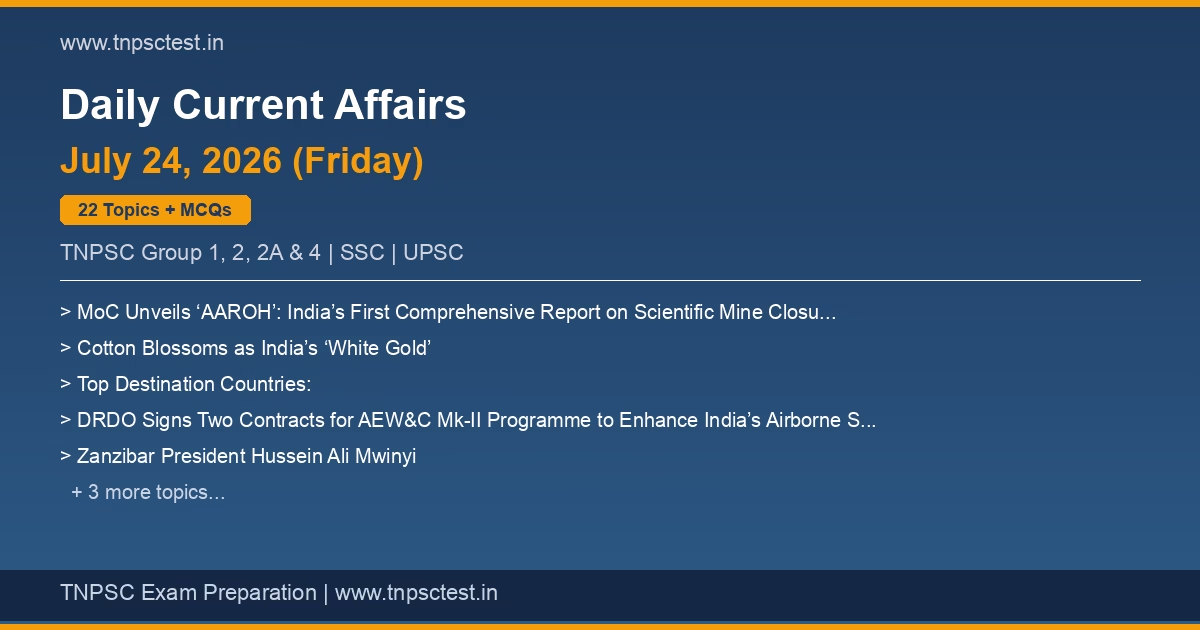
📰 Daily Current Affairs
July 24, 2026 (Friday)
Comprehensive compilation for TNPSC Group 1, 2, 2A & 4 | 22 Important Topics Covered
Welcome to today’s TNPSC Daily Current Affairs for July 24, 2026.
This comprehensive compilation covers all important events across national politics,
international relations, science & technology, economy, sports, and more.
Sourced from The Hindu, Indian Express, PIB, and other reputed media.
Perfect for TNPSC Group 1, Group 2, Group 2A, and Group 4 exam preparation.
📅 Weekly revision hub: For exam-focused consolidation and MCQs for this week,
open the TNPSC weekly current affairs compilation →
📌 Read in Tamil: தமிழில் படிக்க இங்கே கிளிக் செய்யவும்
📝 Total Topics: 20 important events covered
📚 Exam Relevance: TNPSC Group 1, 2, 2A, 4 | SSC | UPSC Prelims
📰 Sources: The Hindu, Indian Express, PIB
Table of Contents
- 🏛️ National Politics & Government
- 1. MoC Unveils ‘AAROH’: India’s First Comprehensive Report on Scientific Mine Closure
- 2. Cotton Blossoms as India’s ‘White Gold’
- 3. Top Destination Countries:
- 4. DRDO Signs Two Contracts for AEW&C Mk-II Programme to Enhance India’s Airborne Surveillance Capability
- 5. Zanzibar President Hussein Ali Mwinyi
- 6. NCVET Recognises NIRDPR as Dual Awarding Body to Strengthen NSQF-Aligned Skill Certification
- 7. DIBD and Goa Government Organised ‘BHASHINI
- 8. NABARD Signs MoU with MAHAPREIT to Promote Green Infrastructure in Rural India
- 9. Microsoft India and IIT Delhi Unveil ‘UNNATI AI 2.0’ to Accelerate India’s AI Innovation Ecosystem
- 🌍 International Affairs
- 10. UN SOFI report: Global hunger Marginally Declines in 2025 but world remains off track for zero hunger goal
- 💰 Economy & Banking
- 11. EbixCashBecame India’s 1st AD-II Entity to Receive RBI Approval for Trade RemittancesIn July 2026,Eb
- 12. ICRA Projects India’s GDP Growth at 6.4–6.6% in Q1 FY27
- 13. Paras Semiconductors,
- 14. APPOINTMENTS & RESIGNATIONS
- 15. Centre Appoints Senior IAS Officer Anurag Jain as NITI Aayog CEO
- 16. ACQUISITIONS & MERGERS
- 🏏 Sports
- 17. PCI and CPSFI Sign MoU to Bid for 2029 World
- 📘 General Knowledge & Miscellaneous
- 18. National Flag Adoption Day 2026 – July 22
- 19. National Broadcasting Day 2026 – July 23
- 20. Evolution of Broadcasting in India:
- 📝 Practice Questions (MCQs)
- Q1. In which year did the following take place? — “Food and Agriculture Organization(FAO)released its latest report titled“The State of Food Security and Nutrition in the World (SOFI _____): Understand”
- Q2. In which year did the following take place? — “Evolution of Broadcasting in India:First Broadcast:The Radio Club of Bombay conducted India’s first radio broadcast in June _____, marking the beginni”
- Q3. In which year did the following take place? — “India from 17–20 July _____President of Zanzibarand Chairman of the Revolutionary Council,Hussein Ali Mwinyi, paid an official visit to India from 17–”
- Q4. In which year did the following take place? — “nBroadcasting Company(IBC)from Bombay (now Mumbai, Maharashtra) in _____, highlighting the role of radio broadcasting in public service communication,”
- Q5. In which year did the following take place? — “22 Julyto commemorate the adoption of the Indian National Flag (Tiranga) by the Constituent Assembly of India on 22 July _____, honouring its role as ”
🏛️ National Politics & Government
1. MoC Unveils ‘AAROH’: India’s First Comprehensive Report on Scientific Mine Closure
- What happened: MoC Unveils ‘AAROH’: India’s First Comprehensive Report on Scientific Mine ClosureIn July 2026, the Ministry of Coal (MoC) released the ‘AAROH: Annual Report on Mine Closure’, at the Oberoi, New Delhi, Delhi showcasing India’s advancements in scientific mine closure, ecological restoration and sustainable utilization of post-mining land.Prepared by:TheCoal Controller Organisation (CCO)developed the “ARROH report”, India’s 1st comprehensive documentation of scientific mine closure and repurposing practices.Objective:The report documents the transformative journey of42 scientifically closed coal mines(33 closed in the last year alone),highlighting structured mine closure and reclamation processes.Virtual Inauguration:The minister also virtually inaugurated Coal NEER Plants established by Coal India Limited through its subsidiaries: Tripartite MoU:Bharat Coking Coal Limited (BCCL) and the Jharia Rehabilitation and Development Authority (JRDA) signed a tripartite Memorandum of Understandings (MoU) with:.
- Key points: Bharat Coking Coal Limited (BCCL),; Central Coalfields Limited (CCL),; Mahanadi Coalfields Limited (MCL), and; South Eastern Coalfields Limited (SECL).
- Why it matters for TNPSC: Polity & Governance (GS Paper 2). Government policies and administration.
2. Cotton Blossoms as India’s ‘White Gold’
- What happened: Cotton Blossoms as India’s ‘White Gold’:India Tops in Cultivation, 2nd inBoth Production & ConsumptionIn July 2026, the Government of India(GoI)released afactsheethighlightingCottonas India’s “White Gold”, supporting the livelihoods of around 6 million farmers and 40–50 million people across the textile value chain. Key Facts:Cotton Production:As per the Ministry of Textiles (MoT) data, India’s cotton production is projected at290.91 lakh balesor, 4.95 Million Tonnes (MT)for 2025-26 (provisional).
- Key details: Cotton Consumption:Also, cotton domestic consumption, including non-textile segments, Micro, Small and Medium Enterprises (MSME), and non-MSME, stood at 328 lakh bales or 5.58 MT, for 2025-26 (provisional).Exports:The data estimated that India exported 18 lakh bales or, 0.31 million Metric Tonnes(MMT) of cotton in 2024-25, representing nearly 3.37% of global cotton exports (541.69 lakh bales or, 9.21 MMT).
- Key points: India ranks1stglobally in cotton cultivation area, with 114.84 lakh hectares(ha) (38% of the world’s cotton area), and2ndin both cotton production and consumption.; India contributes approximately 19% of global fibre production.; However, in terms of value, India’s total cotton exports stood at USD 11.49 billion in Financial Year 2024-25 (FY25).
- Why it matters for TNPSC: Polity & Governance (GS Paper 2). Government policies and administration.
3. Top Destination Countries:
- What happened: Top Destination Countries:The Ministry of Commerce and Industry (MoC&I) data showedthe United States of America (USA)emerged as the largest destination for India’s cotton fabrics and made-up exports (which accounts 26.35% of total exports); followed by Bangladesh (19.81%); Sri Lanka (5.11%); the United Kingdom (UK) (2.38%) and the United Arab Emirates (UAE) (2.32%).
- Why it matters for TNPSC: Polity & Governance (GS Paper 2). Government policies and administration.
4. DRDO Signs Two Contracts for AEW&C Mk-II Programme to Enhance India’s Airborne Surveillance Capability
- What happened: DRDO Signs Two Contracts for AEW&C Mk-II Programme to Enhance India’s Airborne Surveillance CapabilityOn 22 July 2026, the Defence Research and Development Organisation(DRDO)signed two major industry contracts for theAirborne Early Warning and Control (AEW&C) Mk-II Programmeto enhance India’s indigenous airborne surveillance and air defence capabilities. Highlights of the AEW&C Mk-II Programme :Background:Approved by the Cabinet Committee on Security (CCS) inJuly 2025with an outlay ofRs.
- Key details: 19,000 crore,the programme uses Airbus A321 aircraft acquired from Air India, with induction planned for 2032–2033.Aircraft Conversion:CABS partnered with AIESL for the conversion of six Airbus A321 aircraft from commercial to green configuration, which will serve as the AEW&C Mk-II platform.Mission Development:CABS selected ADSTL as the Development-cum-Production Partner(DcPP)for developing mission systems.
- Key points: The contracts were signed by the Centre for Air Borne Systems (CABS), a DRDO laboratory, with AI Engineering Services Limited (AIESL), New Delhi and Adani Defence Systems and Technologies Limited (ADSTL), Ahmedabad in the presence of Rajesh Kumar Singh, Defence Secretary, Secretary (DRDO) and Chairman, DRDO, in New Delhi, Delhi; The integrated aircraft will undergo flight testing with the Indian Air Force (IAF) and certification by Centre for Military Airworthiness and Certification (CEMILAC) and Directorate General of Aeronautical Quality Assurance (DGAQA).
- Why it matters for TNPSC: Polity & Governance (GS Paper 2). Government policies and administration.
5. Zanzibar President Hussein Ali Mwinyi
- What happened: Zanzibar President Hussein Ali MwinyiVisits India from 17–20 July 2026President of Zanzibarand Chairman of the Revolutionary Council,Hussein Ali Mwinyi, paid an official visit to India from 17–20 July 2026 at the invitation of Vice President C. P.
- Key details: Radhakrishnan, accompanied by First Lady Mariyam Mwinyi and a high-level delegation comprising ministers and senior officials. Highlights of the Visit:Bilateral Talks:PresidentHussein Ali Mwinyiheld bilateral discussions with Vice President (VP)Radhakrishnan, reviewing India–Tanzania relations and exploring cooperation in the blue economy, tourism, technology, health, education, trade, and investment, while inviting the Vice President to visit Tanzania.EAM Meeting:He also metUnion Minister Dr. S.
- Key points: During the visit, both sides welcomed the expansion of bilateral trade, investment, and capacity-building initiatives, further reinforcing the India–Tanzania Strategic Partnership.
- Why it matters for TNPSC: Polity & Governance (GS Paper 2). Government policies and administration.
6. NCVET Recognises NIRDPR as Dual Awarding Body to Strengthen NSQF-Aligned Skill Certification
- What happened: NCVET Recognises NIRDPR as Dual Awarding Body to Strengthen NSQF-Aligned Skill CertificationIn July 2026, the National Council for Vocational Education and Training(NCVET)signed anagreementwith National Institute of Rural Development and Panchayati Raj(NIRDPR),under the Ministry of Rural Development (MoRD), grantingNCVET recognitionas an Awarding Body(AB-Dual). About NCVET Recognition:Certification Authority:The recognition enables NIRDPR to assess, certify, and award NSQF-aligned qualifications through its own and affiliated training centres, strengthening rural skilling, vocational education, and entrepreneurship.Qualifications:Under the initial rollout, NCVET approved two NIRDPR qualifications: Industrial General Pest Management Technician and a Micro-Credential on Generation and Mobilisation of Own Source Revenue by Panchayats.Planned Categories:NIRDPR will roll out NCVET-approved programmes for rural youth, SHGs, and Panchayati Raj functionaries, focusing on industry skills, entrepreneurship, and capacity building.Awarding Bodies:NCVET-recognised Awarding Bodies certify NSQF-aligned qualifications under two categories: Standard (certificate awarding only) and Dual (assessment, certification, and awarding).
- Key points: The agreement-signing ceremony was chaired by Niranjan Kumar Sudhansu, Additional Secretary, Ministry of Skill Development and Entrepreneurship (MSDE), and Executive Member of NCVET, in the presence of officials from NCVET and NIRDPR.; As of July 2026, NCVET has recognised 52 Standard and 107 Dual Awarding Bodies.
- Why it matters for TNPSC: Polity & Governance (GS Paper 2). Government policies and administration.
7. DIBD and Goa Government Organised ‘BHASHINI
- What happened: DIBD and Goa Government Organised ‘BHASHINIRajyam’ to Advance AI-Powered Governance in Konkani and Indian LanguagesOn 21 July 2026, the Digital India BHASHINI (BHASHa INterface for India) Division(DIBD)under Digital India Corporation (DIC), the Ministry of Electronics and Information Technology (MeitY), in collaboration with the Department of Information Technology (IT), Electronics & Communications (EC),Government of Goa, organised the‘BHASHINIRajyam: State Engagement Workshop’in Panaji, Goa. About BHASHINIRajyamWorkshop:Aim:The workshop aimed to promote multilingual Artificial Intelligence (AI), strengthened theKonkani languageecosystem, and expanded AI-powered multilingual access to citizen-centric government services.AI Solutions:The workshop showcasedBHASHINI App(application)Mitra,BHASHINI Mitra, andBHASHINIPravakta, with live demonstrations of AI-powered translation, speech recognition, transcription, text-to-speech, transliteration, multilingual Application Programming Interfaces (APIs), and a voice-enabled citizen journey.About DIBD:Established in2022,under DIC, MeitY, is India’s national platform for AI-powered multilingual digital inclusion.
- Key points: The event was attended by Goa Chief Minister (CM)Dr. Pramod SawantandRohan A.Khaunte,Ministers for IT, EC, Tourism, Printing & Stationery, Goa. .; It supports over 800 government websites, processes around 8 billion AI inferences (including nearly 20 million AI inferences daily), and provides services in 36 Indian text languages, 23 Indian voice languages, and 35 international languages.
- Why it matters for TNPSC: Polity & Governance (GS Paper 2). Government policies and administration.
8. NABARD Signs MoU with MAHAPREIT to Promote Green Infrastructure in Rural India
- What happened: NABARD Signs MoU with MAHAPREIT to Promote Green Infrastructure in Rural IndiaIn July 2026, the National Bank for Agriculture and Rural Development (NABARD) signed a Memorandum of Understanding (MoU) with Mahatma Phule Renewable Energy and Infrastructure Technology Limited (MAHAPREIT), a Government of Maharashtra enterprise, to jointly finance and promote green, climate-resilient and sustainable infrastructure projects across rural India, with an initial focus onMaharashtra.Key Details of MoU:Partnership Role:The partnership seeks to combine NABARD’s expertise in rural development finance and climate financing with MAHAPREIT’s experience in Renewable Energy(RE) and sustainable infrastructure projectsPriority Areas:In the initial phase, the partnership will focus on green energy, decarbonisation of government buildings, Gram Panchayat(GP) infrastructure, rural public institutions, and water pumping schemes.Clean Energy Projects:The collaboration will deploy clean energy solutions across Directorate of Technical Education (DTE) institutions, government and district hospitals, and other rural public service institutions.Sustainable Financing:The partnership will finance biogas and bioenergy projects using agricultural residues and biomass, creating additional income opportunities for farmers and promoting the circular economy.
- Key points: It will also support solar-powered micro cold storage infrastructure for village-level bodies.
- Why it matters for TNPSC: Polity & Governance (GS Paper 2). Government policies and administration.
9. Microsoft India and IIT Delhi Unveil ‘UNNATI AI 2.0’ to Accelerate India’s AI Innovation Ecosystem
- What happened: Microsoft India and IIT Delhi Unveil ‘UNNATI AI 2.0’ to Accelerate India’s AI Innovation EcosystemIn July 2026,Microsoft India, in collaboration with the Foundation for Innovation and Technology Transfer (FITT), Indian Institute of Technology (IIT) Delhi, launchedUNNATI AI 2.0(‘Unnati se Pragati’ means progress through growth), second phase of its flagship Corporate Social Responsibility (CSR) initiative.About UNNATI AI 2.0 Initiative:UNNATI AI 2.0:Builds on the first edition, it aims to strengthen India’s Artificial Intelligence(AI) talent pipeline by democratizing AI access, fostering startups, nurturing talent, and expanding innovation opportunities in Tier 2 and Tier 3 cities.Objective:UNNATI AI 2.0 will expands AI skills across developers, entrepreneurs, researchers, students, innovators and facilitates startup enablement, mentorship, and real-world pilot deployments.Significance:It strengthens India’s innovation ecosystem and supports the country’s technology-led progress by responsible, and scalable AI solutions across healthcare, education, agriculture and sustainability.First edition:Launched in April 2025, UNNATI AI accelerated AI startups in healthcare, education, agriculture, and sustainability while providing nationwide AI skilling for developers.
- Key points: Within a year, it supported 10 AI startups, trained over 1,000 developers, and created a Rs. 1,690 crore portfolio.
- Why it matters for TNPSC: Polity & Governance (GS Paper 2). Government policies and administration.
🌍 International Affairs
10. UN SOFI report: Global hunger Marginally Declines in 2025 but world remains off track for zero hunger goal
- What happened: UN SOFI report: Global hunger Marginally Declines in 2025 but world remains off track for zero hunger goalIn July 2026, the United Nations (UN) Food and Agriculture Organization(FAO)released its latest report titled“The State of Food Security and Nutrition in the World (SOFI 2026): Understanding and Addressing the High Cost of a Healthy Diet”.The report estimated645 million people(accounting for7.8%of the global population) faced hunger in 2025, marking a slight decline compared to the previous year (8.1%). About UN’s SOFI Report:Prepared by:The report is prepared by5specialized agencies of the UN: Food and Agriculture Organisation (FAO), International Fund for Agricultural Development (IFAD), UN Children’s Fund (UNICEF), World Food Programme (WFP) and World Health Organisation (WHO).Global Hunger:Despite the progress, the number continues to be 61 million higher than pre-COVID-19 pandemic levels (2019).
- Key details: Key Projection:The report further estimated that the number of chronically undernourished people could decrease to nearly511 million by 2030under a quick-recovery scenario. Epicentre of Hunger:For the first time since such data has been tracked,Africahas replaced Asia as the region with the largest number of undernourished people. India’s Performance:Undernourished people (142.5 million, -42% in 20 years); CoHD (USD 4.11 per person per day in PPP); Affordable Healthy Diet (520.1 million).
- Key points: However, the world is still far off track to meet the UN-mandated Sustainable Development Goal(SDG-2) i.e. zero hunger by 2030.; Also, the prevalence of hunger is slightly lower, at 7.8% (in 2025) compared with 8% (in 2015), when the 2030 Agenda for Sustainable Development (SDG) was launched.; But, if disruption to oil, gas and fertilizer supplies persists, then, the number could be as high as 522 million.
- Why it matters for TNPSC: International Relations (GS Paper 2). Bilateral and multilateral agreements.
💰 Economy & Banking
11. EbixCashBecame India’s 1st AD-II Entity to Receive RBI Approval for Trade RemittancesIn July 2026,Eb
- What happened: EbixCashBecame India’s 1st AD-II Entity to Receive RBI Approval for Trade RemittancesIn July 2026,EbixCashWorld Money Limitedbecame thefirstAuthorised Dealer Category-II(AD-II) entityin India to secure the Reserve Bank of India(RBI)authorisation to offertrade remittancesand family maintenance remittances, which was previously dominated by banks.Key Details:Expanded Services:The enhanced licence will enable EbixCash to facilitate trade remittances up toRs 25 lakhper transaction and process family maintenance remittances under the updated Foreign Exchange Management Act (FEMA), 1999 framework introduced in May 2026.Support for MSMEs:The licence will enable EbixCash to directly serve Micro, Small and Medium Enterprises (MSMEs) involved in import and export activities by facilitating trade-related remittance services.Other Key Approval:EbixCash has also received RBI authorisation to maintainNostroaccounts, enabling direct settlements of international transactions without routing them through intermediary correspondent banks.EbixCash:It was initially established as a Full Fledged Money Changer (FFMC) in 1999 and was later upgraded to RBI-regulated AD-II category entity. Its corporate headquarters is located in Noida, Uttar Pradesh(UP).
- Key details: EnKashIntroduces India’s First Meal Card with UPI PaymentsIn July 2026,Enkash,India’s leading business payments and spend management platform, became the1st company in India to launch Unified Payments Interface(UPI)-based paymentson themeal card. AboutIndia’s First Meal Card:Supported by:The newly launched UPI-enabled Meal Card is supported by the company’s existing payments and prepaid infrastructure, which offers businesses a wider payments suite covering prepaid cards, employee benefits, expense management, among others.Benefit:The new initiative will provide meal benefits of up to Rs 200 per meal under both old and revised tax regimes, leading to annual tax savings of maximum Rs 1,05,600.Enkash:Established in 2018, EnKash is India’s first full-stack payments and spend management platform. It holds Payment Aggregator (PA), Prepaid Payment Instrument (PPI), and Bharat Connect (BBPOU) licences and is headquartered in Mumbai, Maharashtra.
- Key points: This move will enable the employees to make direct payments from their meal balance by scanning eligible UPI Quick Response (QR) codes at food and grocery merchants.
- Why it matters for TNPSC: Economy (GS Paper 3). Banking, monetary policy, fiscal developments.
12. ICRA Projects India’s GDP Growth at 6.4–6.6% in Q1 FY27
- What happened: ICRA Projects India’s GDP Growth at 6.4–6.6% in Q1 FY27In July 2026,ICRA Limited, a domestic credit rating agency, projected India’s real Gross Domestic Product(GDP) growthat6.4–6.6%for the first quarter(Q1)(April–June) of Financial Year 2026-27(FY27),driven by broad-based economic activity despite elevated energy prices and limited input availability affecting margins across key sectors. About ICRA’s GDP Projection:Growth:ICRA’s Business Activity Monitor(BAM)recorded 12% year-on-year (YoY) growth in June 2026, the highest in 32 months, up from 9.4% in May 2026, with 13 of 16 high-frequency indicators showing faster growth.Drivers:Growth was supported by the temporary United States of America (USA)–Iran ceasefire, a 40% rainfall deficit that extended construction and mining activity, and a favourable base effect, while 10 of 17 non-agricultural indicators improved during Q1 FY27.Industry:Based on 5% YoY growth in the Index of Core Industries, ICRA projected the Index of Industrial Production (IIP) to grow5–6%in June 2026.Significance:The report indicates sustained economic momentum driven by industrial and infrastructure activity despite rising energy prices, supply-side constraints, and pressure on manufacturing profit margins.
- Key points: India’s real GDP grew by7.8%in Q4(January–March) of FY26.
- Why it matters for TNPSC: Economy (GS Paper 3). Banking, monetary policy, fiscal developments.
13. Paras Semiconductors,
- What happened: Paras Semiconductors,MPSeDCSign MoU to Establish Greenfield OSAT Facility in MPIn July 2026,Paras SemiconductorsPrivate Limited, a subsidiary of Paras Defence and Space Technologies Limited (PDST), signed a Memorandum of Understanding(MoU)with the Madhya Pradesh State Electronics Development Corporation(MPSeDC)to establish agreenfieldOutsourced Semiconductor Assembly and Test(OSAT) facilityin theIndore–Ujjainregion of MP with a proposed investment ofRs.6,200 crore. About OSAT Facility in MP:Technology:The facility will undertake advanced semiconductor packaging operations, including Three-Dimensional (3D) heterogeneous integration,2.5D/3D packaging, hybrid bonding, ultra-high-density fan-out packaging, chiplet integration, wafer bumping, flip-chip assembly, testing, and reliability validation.Applications:The plant will initially manufacture semiconductor devices for sensor technologies, optical and optronic systems, and other strategic applications, with future expansion into Artificial Intelligence (AI) chips and advanced semiconductor products.Significance:The project will strengthen MP as a semiconductor hub, reduce import dependence, and support the India Semiconductor Mission (ISM) and India’s semiconductor value chain.
- Key points: The project aims to strengthen India’s semiconductor packaging ecosystem, enhance indigenous semiconductor capabilities, generate employment, and support the India Semiconductor Mission.
- Why it matters for TNPSC: Economy (GS Paper 3). Banking, monetary policy, fiscal developments.
14. APPOINTMENTS & RESIGNATIONS
- What happened: APPOINTMENTS & RESIGNATIONS.
- Why it matters for TNPSC: Economy (GS Paper 3). Banking, monetary policy, fiscal developments.
15. Centre Appoints Senior IAS Officer Anurag Jain as NITI Aayog CEO
- What happened: Centre Appoints Senior IAS Officer Anurag Jain as NITI Aayog CEOIn July 2026, Government of India (GoI) appointed Anurag Jain as new Chief Executive Officer (CEO) of (National Institution for Transforming India)NITI Aayog, approved by the Appointments Committee of the Cabinet (ACC) as per the Department of Personnel and Training (DoPT) order. Key Details of Appointment:Profile:A 1989-batch Indian Administrative Service (IAS) officer of the Madhya Pradesh (MP) cadre with nearly four decades of administrative experience, having held several key positions in both the Central and State governments.Responsibilities:As CEO of NITI Aayog, Jain will steer national policy formulation, strategic governance reforms, cooperative federalism initiatives, and long-term development planning across sectors.
- Key points: He succeedsNidhi Chhibber,, Director General (DG) of NITI Aayog’s Development Monitoring and Evaluation Office (DMEO), who had been holding the additional charge ofCEOsince February 24, 2026, following the completion of B.V.R. Subrahmanyam’s extended tenure in February 2023.; He assumes charge immediately for a tenure oftwo yearsor until further orders, whichever is earlier.
- Why it matters for TNPSC: Economy (GS Paper 3). Banking, monetary policy, fiscal developments.
16. ACQUISITIONS & MERGERS
- What happened: ACQUISITIONS & MERGERS RBI ApprovesAreionGroup’s Rs. 936 Crore Acquisition ofAviomIndia Housing FinanceInJuly 2026, the Reserve Bank of India(RBI)approvedAreionGroup’s Rs.
- Key details: 936 crore acquisitionofAviomIndia Housing Finance,a fraud-hit housing finance company marking a key step in the company’s insolvency resolution process. Highlights of the Approval:Background:Aviom India Housing Finance entered the Corporate Insolvency Resolution Process(CIRP)inFebruary 2025due to debt defaults and accounting irregularities.Acquisition:Areion Group emerged as the successful resolution applicant with an unconditional resolution plan worth Rs. 936 crore, offering lenders an estimated recovery of around 65%.Why Areion’s Bid Was Selected: Although Unity Small Finance Bank submitted a higher bid of Rs.
- Key points: The RBI also granted‘fit-and-proper’ approvaltoManishLalwani, promoter of Areion Group, which is mandatory for a change in control of a regulated financial institution.
- Why it matters for TNPSC: Economy (GS Paper 3). Banking, monetary policy, fiscal developments.
🏏 Sports
17. PCI and CPSFI Sign MoU to Bid for 2029 World
- What happened: PCI and CPSFI Sign MoU to Bid for 2029 WorldAbilitysportGamesOn 22 July 2026, the Paralympic Committee of India(PCI)and the Cerebral Palsy Sports Federation of India(CPSFI)signed a Memorandum of Understanding (MoU) in New Delhi, Delhi to jointly pursue India’s bid to host the2029 WorldAbilitysportGames. Highlights of the Bid for WorldAbilitysportGames:Background:India previously hosted the International Wheelchair and Amputee Sports Federation (IWAS) World Games in Bengaluru, Karnataka in 2009.Host Cities:Chennai (Tamil Nadu, TN) and Bhubaneswar (Odisha) are under consideration as host cities for the 2029 World Abilitysport Games, based on infrastructure, accessibility and Games readiness.Participants:The 2029 World Abilitysport Games are expected to feature1,500+ participantsacross Para sports disciplines including Para Athletics, Para Swimming, Para Badminton, Para Fencing, CP Football, Para Table Tennis and Para Wheelchair Basketball (3-a-side).About PCI:The PCI, established in 1992 and headquartered in New Delhi(Delhi), is the national governing body for promoting and managing Para sports in India, headed by Devendra Jhajharia (President).
- Key points: The partnership aims to prepare and submit a competitive bid to bring the international multi-sport event for athletes with disabilities to India, strengthening the country’s role in the globalParalympic movement.
- Why it matters for TNPSC: Sports Current Affairs. Awards and achievements of sportspersons.
📘 General Knowledge & Miscellaneous
18. National Flag Adoption Day 2026 – July 22
- What happened: National Flag Adoption Day 2026 – July 22National Flag Adoption Dayis observed annually on22 Julyto commemorate the adoption of the Indian National Flag (Tiranga) by the Constituent Assembly of India on 22 July 1947, honouring its role as a symbol of freedom, justice, liberty, and equality. About Indian National Flag:Early Design:The design of the Indian National Flag was inspired by the Swaraj Flag, first presented byPingali Venkayyain1921.
- Key details: Tricolour:In 1921, Mahatma Gandhi proposed a tricolour flag with a spinning wheel (Charkha) to symbolise progress. The Charkha was later replaced by the24-spokenavy blueAshoka Chakra, designed by Badruddin Tyabji.Dimensions:The Indian National Flag has a length-to-width ratio of3:2.Flag Code Amendment:Effective26 January 2002, the Flag Code of India was amended to allow citizens to hoist the National Flag at their homes, offices, and other places on any day, and not just on national occasions.
- Key points: 22 July 2026marks the79thNational Flag Adoption Day.; The Swaraj Flag featured three horizontal stripes in red, yellow, and green, with a white crescent and star at the centre.
- Why it matters for TNPSC: General Knowledge. Important for TNPSC prelims.
19. National Broadcasting Day 2026 – July 23
- What happened: National Broadcasting Day 2026 – July 23National Broadcasting Dayis observed annually on23 Julyacross India to commemorate thefirst radio broadcastby the IndianBroadcasting Company(IBC)from Bombay (now Mumbai, Maharashtra) in 1927, highlighting the role of radio broadcasting in public service communication, education, entertainment and cultural preservation.
- Key points: 2026marks the99thanniversary of India’s first organised radio broadcast.
- Why it matters for TNPSC: General Knowledge. Important for TNPSC prelims.
20. Evolution of Broadcasting in India:
- What happened: Evolution of Broadcasting in India:First Broadcast:The Radio Club of Bombay conducted India’s first radio broadcast in June 1923, marking the beginning of radio communication.IBC Formation:The IBC started organised radio broadcasting on23 July 1927from Bombay.Government Control:Following the liquidation of IBC, the Government of India established the Indian State Broadcasting Service(ISBS)in1930.All India Radio (AIR):On8 June 1936, ISBS was renamed AIR, becoming India’s official public broadcaster.Akashvani:In1956, AIR adopted the nameAkashvani, meaning “celestial voice” in Sanskrit. *******.
- Why it matters for TNPSC: General Knowledge. Important for TNPSC prelims.
📝 Practice Questions (MCQs)
Test your knowledge with these questions based on today’s current affairs. Each question has one correct answer — click to reveal it after you decide.
Q1. In which year did the following take place? — “Food and Agriculture Organization(FAO)released its latest report titled“The State of Food Security and Nutrition in the World (SOFI _____): Understand”
(a) 2022
(b) 2026
(c) 2018
(d) 2032
Click to see Answer
Answer: (b) 2026
Explanation: The correct year is 2026. Source: UN SOFI report: Global hunger Marginally Declines in 2025 but world remains off track for zero hunger goal
Q2. In which year did the following take place? — “Evolution of Broadcasting in India:First Broadcast:The Radio Club of Bombay conducted India’s first radio broadcast in June _____, marking the beginni”
(a) 1919
(b) 1923
(c) 1934
(d) 1929
Click to see Answer
Answer: (b) 1923
Explanation: The correct year is 1923. Source: Evolution of Broadcasting in India:
Q3. In which year did the following take place? — “India from 17–20 July _____President of Zanzibarand Chairman of the Revolutionary Council,Hussein Ali Mwinyi, paid an official visit to India from 17–”
(a) 2022
(b) 2018
(c) 2032
(d) 2026
Click to see Answer
Answer: (d) 2026
Explanation: The correct year is 2026. Source: Zanzibar President Hussein Ali Mwinyi
Q4. In which year did the following take place? — “nBroadcasting Company(IBC)from Bombay (now Mumbai, Maharashtra) in _____, highlighting the role of radio broadcasting in public service communication,”
(a) 1927
(b) 1938
(c) 1923
(d) 1933
Click to see Answer
Answer: (a) 1927
Explanation: The correct year is 1927. Source: National Broadcasting Day 2026 – July 23
Q5. In which year did the following take place? — “22 Julyto commemorate the adoption of the Indian National Flag (Tiranga) by the Constituent Assembly of India on 22 July _____, honouring its role as ”
(a) 1943
(b) 1953
(c) 1947
(d) 1958
Click to see Answer
Answer: (c) 1947
Explanation: The correct year is 1947. Source: National Flag Adoption Day 2026 – July 22
🔄 தமிழில் படிக்க / Read in Tamil
Get daily current affairs, study tips, and exam notifications delivered free.