
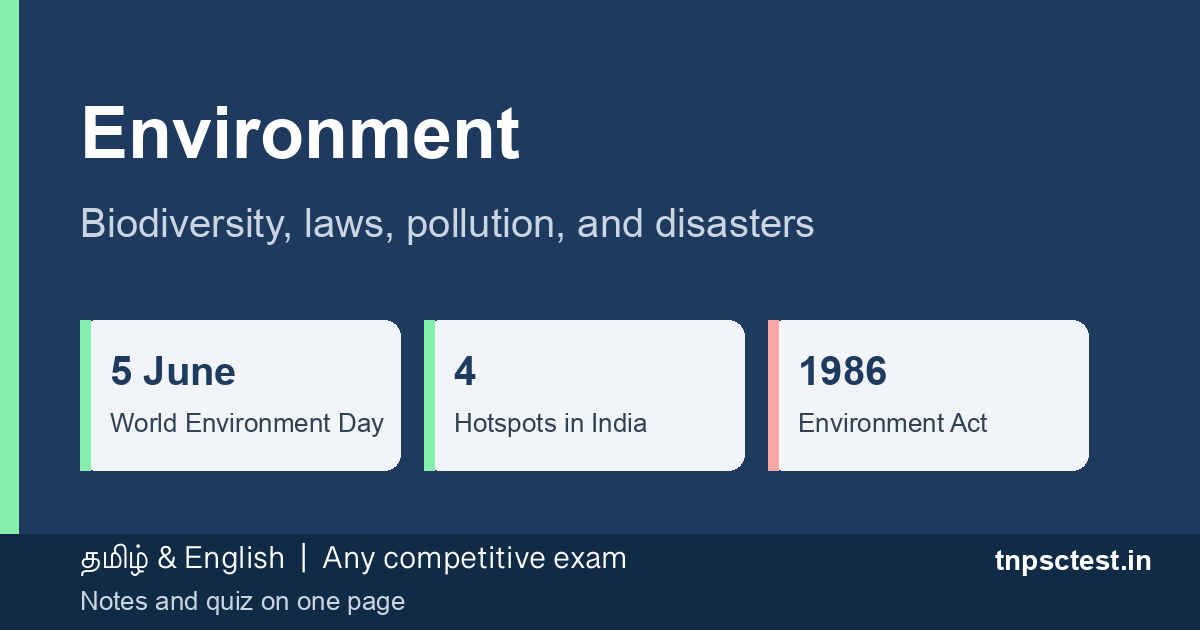
Environment Notes: Biodiversity, Laws, Pollution, and Disasters in Short Lines
Environment notes for any competitive exam aspirant in India, on one page. Short lines. Tamil first, then English. The quiz is only in the Quiz section at the end of this page.
நினைவு
- உலக சுற்றுச்சூழல் நாள் ஜூன் 5. புவி நாள் ஏப்ரல் 22. உலக ஈரநில நாள் பிப்ரவரி 2.
- உலக வனவிலங்கு நாள் மார்ச் 3. உலக வன நாள் மார்ச் 21. உலக நீர் நாள் மார்ச் 22.
- பல்லுயிர் நாள் மே 22. ஓசோன் பாதுகாப்பு நாள் செப்டம்பர் 16. உலகப் புலிகள் நாள் ஜூலை 29.
- ஸ்டாக்ஹோம் மாநாடு 1972. ரியோ புவி உச்சி மாநாடு 1992. பாரிஸ் ஒப்பந்தம் 2015.
- சுற்றுச்சூழல் (பாதுகாப்பு) சட்டம் 1986. அது போபால் வாயுக் கசிவுக்குப் (1984) பிறகு இயற்றப்பட்டது.
- வனவிலங்கு பாதுகாப்புச் சட்டம் 1972. பல்லுயிர் சட்டம் 2002. தேசிய பசுமைத் தீர்ப்பாயம் 2010.
- சட்டப்பிரிவு 48-ஏ சுற்றுச்சூழலைக் காக்க அரசுக்கு வழிகாட்டுகிறது. சட்டப்பிரிவு 51-ஏ(ஜி) அதைக் குடிமக்களின் கடமையாக்குகிறது.
- சில நூல்களில் பொதுப் பொறுப்புக் காப்பீட்டுச் சட்டம் 1981 எனத் தவறாக உள்ளது. சரியான ஆண்டு 1991.
சூழல் மண்டலம்
- சூழல் மண்டலத்தில் உயிருள்ளவை, உயிரற்றவை என இரு கூறுகள் உள்ளன. சூரிய ஒளியே ஆற்றலின் மூலம்.
- உற்பத்தியாளர்கள் பசுந்தாவரங்கள். நுகர்வோர் விலங்குகள். சிதைப்பவை பூஞ்சைகளும் நுண்ணுயிரிகளும்.
- ஆற்றல் ஒரே திசையில் செல்லும். சத்துகள் சுழற்சியாகத் திரும்பும்.
- லிண்டமனின் 10 விழுக்காடு விதி: ஒரு உணவு நிலையிலிருந்து அடுத்த நிலைக்கு 10 விழுக்காடு ஆற்றலே செல்லும்.
- உணவுச் சங்கிலிகள் பின்னிக் கொண்டால் அது உணவு வலை.
- ஆற்றல் பிரமிடு எப்போதும் நேராக இருக்கும். எண்ணிக்கைப் பிரமிடு சில இடங்களில் தலைகீழாக இருக்கும்.
- ஒரு பகுதியில் ஓர் உயிர்ச்சமூகம் படிப்படியாக மற்றொன்றால் மாற்றப்படுவது சூழலியல் தொடர் மாற்றம்.
- முன்னோடி இனங்களில் தொடங்கி, நிலையான உச்ச சமூகத்தில் முடியும்.
- முதல்நிலை மாற்றம் வெற்றுப் பாறையில் தொடங்கும். இரண்டாம்நிலை மாற்றம் காடு அழிந்த இடத்தில் தொடங்கும். மண் ஏற்கெனவே இருப்பதால் அது விரைவாக நடக்கும்.
- நீரில் தொடங்கும் தொடர் மாற்றம் ஹைட்ரார்க். வறண்ட பாறையில் தொடங்குவது செரார்க். இரண்டும் மிதமான ஈரமுள்ள உச்ச சமூகத்தில் முடியும்.
பல்லுயிர்
- பல்லுயிர் மூன்று நிலைகளில் அளக்கப்படும்: மரபணு, இனம், சூழல் மண்டலம்.
- இந்தியாவின் நிலப்பரப்பு உலகத்தில் சுமார் 2.4 விழுக்காடு. ஆனால் உலக உயிரினங்களில் ஏறத்தாழ 8 விழுக்காடு இங்கே உள்ளன.
- இந்தியா 17 மிகுபல்லுயிர் நாடுகளில் ஒன்று. இங்கே 10 உயிர்புவியியல் மண்டலங்கள் உள்ளன.
- நிலநடுக்கோட்டை நோக்கிப் போனால் பல்லுயிர் கூடும். துருவத்தை நோக்கியும் மலையில் ஏறியும் குறையும்.
- தனிச்சிறப்பு இனம் ஒரு பகுதியில் மட்டுமே வாழும். அயல் இனம் வெளியிலிருந்து கொண்டுவரப்பட்டது.
- ஆல்பா பன்மை ஓர் இடத்தின் இனங்களின் எண்ணிக்கை. பீட்டா பன்மை அடுத்தடுத்த இரு இடங்களின் வேறுபாடு. காமா பன்மை முழுப் பகுதியின் பன்மை.
- வெப்ப மையம் ஆவதற்கு இரு நிபந்தனைகள் உண்டு. குறைந்தபட்சம் 1,500 தனிச்சிறப்புத் தாவர இனங்கள் இருக்க வேண்டும். மூல வாழிடத்தில் 70 விழுக்காடு இழக்கப்பட்டிருக்க வேண்டும்.
- நார்மன் மயர்ஸ் வெப்ப மையக் கருத்தை முன்வைத்தவர். உலகில் இப்போது 36 வெப்ப மையங்கள். பழைய நூல்களில் 35 என இருக்கும்.
- இந்தியாவில் 4 வெப்ப மையங்கள்: மேற்குத் தொடர்ச்சி மலையும் இலங்கையும், இமயமலை, இந்தோ-பர்மா, சுந்தாலாந்து.
- சுந்தாலாந்தில் இந்தியாவின் பகுதி நிக்கோபார் தீவுகள்.
- நீலகிரி வரையாடும் சிங்கவால் குரங்கும் மேற்குத் தொடர்ச்சி மலையின் தனிச்சிறப்பு உயிரினங்கள்.
காப்பிடங்கள்
- தன்னிடப் பாதுகாப்பு உயிரினம் வாழும் இடத்திலேயே காப்பது: தேசியப் பூங்கா, சரணாலயம், உயிர்க்கோளக் காப்பகம், கோயில் தோப்பு.
- வெளியிடப் பாதுகாப்பு வாழிடத்துக்கு வெளியே காப்பது: உயிரியல் பூங்கா, தாவரவியல் பூங்கா, மரபணு வங்கி, விதை வங்கி, உறைநிலைப் பாதுகாப்பு.
- தமிழ்நாட்டின் தேசியப் பூங்காக்கள்: கிண்டி (1976), மன்னார் வளைகுடா கடல் (1980), இந்திரா காந்தி ஆனைமலை (1989), முதுமலை (1990), முக்கூர்த்தி (1990).
- வேடந்தாங்கல் சரணாலயம் 1936-இல் தொடங்கியது. அது இந்தியாவின் பழமையான பறவைகள் சரணாலயம் எனப்படுகிறது.
- கோடியக்கரை சரணாலயம் 1967. முதுமலை சரணாலயம் 1942. முண்டந்துறை சரணாலயம் 1977.
- உயிர்க்கோளக் காப்பகங்கள் தமிழ்நாட்டில் மூன்று: நீலகிரி (1986), மன்னார் வளைகுடா (1989), அகத்தியமலை (2001).
- நீலகிரி இந்தியாவின் முதல் உயிர்க்கோளக் காப்பகம். இந்தியாவில் மொத்தம் 18.
- உயிர்க்கோளக் காப்பகத்தில் மையப் பகுதி, இடைப்பகுதி, மாறுநிலைப் பகுதி என மூன்று மண்டலங்கள் உள்ளன.
- புலிகள் திட்டம் 1973-இல் ஜிம் கார்பெட் தேசியப் பூங்காவில் தொடங்கியது. யானைகள் திட்டம் 1992. முதலைகள் திட்டம் 1975.
- தேசியப் புலிகள் பாதுகாப்பு ஆணையம் 2006-இல் சட்ட அதிகாரம் பெற்றது.
- புலி தேசிய விலங்கு. கங்கை ஆற்று ஓங்கில் தேசிய நீர்வாழ் விலங்கு. யானை தேசிய பாரம்பரிய விலங்கு.
- தமிழ்நாட்டின் மாநில விலங்கு நீலகிரி வரையாடு. மாநிலப் பறவை மரகதப் புறா. மாநில மரம் பனை. மாநில மலர் செங்காந்தள். மாநிலப் பட்டாம்பூச்சி தமிழ் மறவன்.
- சிப்கோ இயக்கம் 1973-இல் உத்தரகண்டில் மரங்களைக் கட்டிக்கொண்டு அவற்றைக் காப்பாற்றியது. தலைவர் சுந்தர்லால் பகுகுணா.
உலக ஒப்பந்தங்கள்
- ஸ்டாக்ஹோம் மாநாடு 1972 சுற்றுச்சூழல் சட்டத்தின் தொடக்கம். ரியோ மாநாடு 1992-இல் நிகழ்ச்சி நிரல் 21 உருவானது.
- ரியோவில் மூன்று ஒப்பந்தங்கள் திறக்கப்பட்டன: பல்லுயிர், பருவநிலை, பாலைவனமாதல் தடுப்பு.
- சைட்டீஸ் (CITES) 1973 மார்ச் 3 அன்று கையெழுத்தானது. 1975-இல் நடைமுறையானது. செயலகம் ஜெனீவா.
- சைட்டீஸ் பிரிவு I அழியும் நிலை இனங்கள். வணிகத் தடை. பிரிவு II அனுமதியுடன் வணிகம். பிரிவு III ஒரு நாடு உதவி கேட்கும் இனங்கள்.
- ஐயுசிஎன் 1948 அக்டோபர் 5 அன்று தொடங்கியது. தலைமையகம் சுவிட்சர்லாந்தின் கிளாண்ட்.
- ஐயுசிஎன் செம்பட்டியலில் 9 நிலைகள்: அழிவு, காட்டில் அழிவு, மிக அருகிய நிலை, அருகிய நிலை, பாதிக்கப்படக்கூடியது, அச்சுறுத்தல் அண்மை, குறைந்த கவலை, தரவு போதாமை, மதிப்பீடு இல்லை.
- மிக அருகிய, அருகிய, பாதிக்கப்படக்கூடிய மூன்றும் சேர்ந்து அச்சுறுத்தப்பட்டவை எனப்படும்.
- பல்லுயிர் ஒப்பந்தம் (CBD) 1992 ரியோவில் திறக்கப்பட்டது. 1993-இல் நடைமுறையானது. செயலகம் மாண்ட்ரியல்.
- மூன்று இலக்குகள்: பல்லுயிரைக் காத்தல், நிலைத்த பயன்பாடு, பயனை நியாயமாகப் பகிர்தல்.
- கார்டஜீனா நெறிமுறை மரபணு மாற்றிய உயிர்களின் பாதுகாப்புக்கானது. 2000-இல் ஏற்கப்பட்டு 2003-இல் நடைமுறையானது.
- நகோயா நெறிமுறை மரபணு வளப் பயனைப் பகிர்வது. 2010-இல் ஏற்கப்பட்டு 2014-இல் நடைமுறையானது.
- ஐச்சி இலக்குகள் 2011 முதல் 2020 வரை. அதன் பின் 2022 டிசம்பரில் குன்மிங்-மாண்ட்ரியல் உலகப் பல்லுயிர் கட்டமைப்பு ஏற்கப்பட்டது. அதன் இலக்கு: 2030-க்குள் நிலத்திலும் கடலிலும் 30 விழுக்காடு காத்தல்.
- ராம்சர் ஒப்பந்தம் 1971 ஈரநிலங்களுக்கானது.
- மான்ட்ரியல் நெறிமுறை 1987 ஓசோன் அடுக்குக்கானது. கியோட்டோ நெறிமுறை 1997. பாரிஸ் ஒப்பந்தம் 2015.
சட்டங்கள்
- வனவிலங்கு பாதுகாப்புச் சட்டம் 1972. நீர் (மாசுத் தடுப்பு) சட்டம் 1974. வனப் பாதுகாப்புச் சட்டம் 1980. காற்று (மாசுத் தடுப்பு) சட்டம் 1981.
- மத்திய மாசுக் கட்டுப்பாட்டு வாரியம் 1974-இல் நீர்ச் சட்டத்தின் கீழ் அமைக்கப்பட்டது.
- சுற்றுச்சூழல் (பாதுகாப்பு) சட்டம் 1986 குடைச் சட்டம் எனப்படும். அது நீர், காற்றுச் சட்டங்களை இணைக்கிறது.
- தேசிய வனக் கொள்கை 1988: நிலப்பரப்பில் 33 விழுக்காடு வனம். மலைப் பகுதிகளில் மூன்றில் இரண்டு பங்கு.
- பொதுப் பொறுப்புக் காப்பீட்டுச் சட்டம் 1991. தேசிய சுற்றுச்சூழல் தீர்ப்பாயச் சட்டம் 1995. தேசிய சுற்றுச்சூழல் மேல்முறையீட்டு ஆணையச் சட்டம் 1997.
- ஒலி மாசு விதிகள் 2000. ஓசோன் சிதைவுப் பொருள் விதிகள் 2000.
- பல்லுயிர் சட்டம் 2002. தேசிய பல்லுயிர் ஆணையம் 2003-இல் சென்னையில் அமைக்கப்பட்டது.
- பல்லுயிர் சட்டத்தின் கீழ் மாநிலப் பல்லுயிர் வாரியமும் உள்ளூர் பல்லுயிர் மேலாண்மைக் குழுக்களும் உள்ளன.
- வன உரிமைச் சட்டம் 2006.
- தேசிய பசுமைத் தீர்ப்பாயம் 2010 அக்டோபர் 18 அன்று தொடங்கியது. முதன்மை அமர்வு டெல்லியில் உள்ளது. மண்டல அமர்வுகள் போபால், புனே, கொல்கத்தா, சென்னை.
- சுற்றுச்சூழல் அமைச்சகம் 1985-இல் தனி அமைச்சகமானது. இப்போதைய பெயர் சுற்றுச்சூழல், வனம், பருவநிலை மாற்ற அமைச்சகம்.
- சட்டப்பிரிவு 48-ஏ மற்றும் 51-ஏ(ஜி) இரண்டும் 1976-இல் 42-ஆவது திருத்தம் மூலம் சேர்க்கப்பட்டன.
தாக்க மதிப்பீடு
- சுற்றுச்சூழல் தாக்க மதிப்பீடு என்பது திட்டம் தொடங்கும் முன் அதன் விளைவுகளை முன்கூட்டியே ஆராயும் முறை.
- இந்தியாவில் 1978-இல் ஆற்றுப் பள்ளத்தாக்குத் திட்டங்களுடன் தொடங்கியது.
- 1994 ஜனவரி 27 அன்று சுற்றுச்சூழல் (பாதுகாப்பு) சட்டத்தின் கீழ் அறிவிக்கை வெளியிடப்பட்டு மதிப்பீடு கட்டாயமானது. 2006 செப்டம்பரில் புதிய அறிவிக்கை வெளியானது.
- 2006 அறிவிக்கையில் திட்டங்கள் பிரிவு ஏ, பிரிவு பி என இரண்டாகப் பிரிக்கப்பட்டன. பிரிவு ஏ ஒப்புதல் மத்திய அரசு. பிரிவு பி ஒப்புதல் மாநில மதிப்பீட்டு ஆணையம்.
- எட்டுப் படிகள்: திரையிடல், வரம்பிடல், தாக்கப் பகுப்பாய்வு, தணிப்பு, அறிக்கை, மறுஆய்வு, முடிவு, பின் கண்காணிப்பு.
- பொதுமக்கள் கருத்துக் கேட்பு இந்த நடைமுறையின் ஒரு பகுதி.
- சுற்றுச்சூழல் தணிக்கை ஏற்கெனவே இயங்கும் தொழிற்சாலையின் தாக்கத்தை ஆராயும். தாக்க மதிப்பீடு தொடங்கும் முன் செய்வது.
- குறைகள்: காலம் அதிகம், மக்கள் பங்கேற்பு குறைவு, பின் கண்காணிப்பு குறைவு.
- சூழல் உணர்திறன் மண்டலம் காப்பிடத்தைச் சுற்றியுள்ள தாங்கல் பகுதி. அது சுற்றுச்சூழல் சட்டத்தின் கீழ் அறிவிக்கப்படும்.
- கடலோர ஒழுங்காற்று மண்டல விதிகள் கடற்கரையில் கட்டுமானத்தை ஒழுங்குபடுத்தும்.
மாசு
- காற்றுத் தரக் குறியீடு 2014-இல் தொடங்கியது. ஆறு நிலைகள்: நன்று, திருப்தி, மிதமான மாசு, மோசம், மிக மோசம், கடுமை.
- முதன்மை மாசுகள் நேரடியாக வெளியாகும்: கார்பன் மோனாக்சைடு, சல்பர் டை ஆக்சைடு, நைட்ரஜன் ஆக்சைடுகள். இரண்டாம் நிலை மாசுகள் வினையால் உருவாகும்: தரைமட்ட ஓசோன், புகைமூட்டம்.
- துகள் மாசு PM2.5 நுரையீரலின் ஆழம் வரை செல்லும்.
- அமில மழையின் pH 5.6-க்குக் கீழ் இருக்கும். சல்பர் டை ஆக்சைடும் நைட்ரஜன் ஆக்சைடுகளும் காரணம்.
- தேசியத் தூய காற்றுத் திட்டம் 2019. பிஎஸ்-6 வாகன விதி 2020 ஏப்ரல் முதல்.
- நீரில் கரைந்த ஆக்சிஜன் அதிகம் என்றால் நீர் தூய்மை. உயிர்வேதி ஆக்சிஜன் தேவை அதிகம் என்றால் மாசு அதிகம்.
- ஊட்டச்சத்து மிகுந்து ஏரி பாசியால் மூடுவது ஊட்டமிகை.
- கங்கை செயல்திட்டம் 1985. நமாமி கங்கே 2014.
- மினமாட்டா நோய் பாதரசத்தால் வரும். இடாய்-இடாய் நோய் கேட்மியத்தால் வரும். புளோரோசிஸ் புளோரைடால் வரும்.
- உணவுச் சங்கிலியில் மேல்நிலைக்குப் போகப் போக நச்சு கூடுவது உயிர்ப் பெருக்கம். டிடிடி இதற்கு எடுத்துக்காட்டு.
- ஒலி அளவு டெசிபலில் அளக்கப்படும். குடியிருப்புப் பகுதியில் பகல் 55, இரவு 45 டெசிபல் வரம்பு.
- மின்நிலையங்களின் சூடான நீர் ஆற்றில் கலந்தால் கரைந்த ஆக்சிஜன் குறையும். இது வெப்ப மாசு.
கழிவு மேலாண்மை
- திடக்கழிவு மேலாண்மை விதிகள் 2016 பழைய 2000 விதிகளை மாற்றின. அவை நகராட்சிப் பகுதிக்கு வெளியிலும் பொருந்தும்.
- மூல இடத்திலேயே பிரிக்க வேண்டும்: ஈரக்கழிவு, உலர் கழிவு, ஆபத்தான வீட்டுக் கழிவு.
- கழிவுப் படிநிலை: தவிர்த்தல், குறைத்தல், மறுபயன், மறுசுழற்சி, உரமாக்கல்.
- சென்னையின் பெருங்குடியும் கொடுங்கையூரும் பெரிய குப்பைக் கிடங்குகள்.
- சுகாதாரப் புதைநிலத்தின் அடியில் ஊடுருவாத படலம் இருக்கும். கசிவுநீர் சேகரிக்கப்படும்.
- புழு உரம், உயிர்வாயு, எரியூட்டல், காற்றில்லா வெப்பச் சிதைவு ஆகியவை கழிவு நீக்க முறைகள்.
- மருத்துவக் கழிவுக்கு மஞ்சள், சிவப்பு, வெள்ளை, நீல நிறப் பைகள் உள்ளன. விதிகள் 2016.
- மின்னணுக் கழிவு விதிகள் 2016. புதிய விதிகள் 2022.
- ஆபத்துக் கழிவு விதிகள் 2016. பாசெல் ஒப்பந்தம் 1989 ஆபத்துக் கழிவுகள் எல்லை கடப்பதைக் கட்டுப்படுத்தும்.
- தமிழ்நாட்டில் 2019 ஜனவரி 1 முதல் ஒருமுறை பயன்படுத்தும் சில பிளாஸ்டிக் பொருட்களுக்குத் தடை. நாடு முழுவதும் 2022 ஜூலை 1 முதல் சில வகைகளுக்குத் தடை.
- தூய்மை இந்தியா இயக்கம் 2014 அக்டோபர் 2 அன்று தொடங்கியது.
பருவநிலை
- பசுமை இல்ல வாயுக்கள்: நீராவி, கார்பன் டை ஆக்சைடு, மீத்தேன், நைட்ரஸ் ஆக்சைடு, புளோரின் வாயுக்கள்.
- மீத்தேன் ஒரு மூலக்கூறுக்கு வெப்பத்தைச் சிக்கவைப்பதில் கார்பன் டை ஆக்சைடை விட வலிமையானது.
- ஓசோன் அடுக்கு படைமண்டலத்தில் சுமார் 15 முதல் 35 கி.மீ உயரத்தில் உள்ளது. அது புற ஊதாக் கதிரைத் தடுக்கும். அளவு டாப்சன் அலகு.
- சிஎஃப்சி வாயுக்கள் ஓசோனை அழிக்கும். அண்டார்டிகா ஓசோன் துளை 1985-இல் கண்டறியப்பட்டது.
- கிகாலி திருத்தம் 2016 எச்எஃப்சி வாயுக்களைக் குறைக்கும். அது மான்ட்ரியல் நெறிமுறையின் திருத்தம்.
- கடல் அமிலமாதல்: கார்பன் டை ஆக்சைடு கடலில் கரைந்து pH-ஐக் குறைக்கும். பவளத் திட்டுகளும் சிப்பிகளும் பாதிக்கப்படும்.
- பவள வெளுப்பு கடல் வெப்பம் கூடும்போது நிகழும்.
- ஐநா பருவநிலை கட்டமைப்பு ஒப்பந்தம் 1992. அதன் உறுப்பு நாடுகள் ஆண்டுதோறும் கூடுவது COP.
- பாரிஸ் ஒப்பந்தம் COP21-இல் ஏற்கப்பட்டது. வெப்ப உயர்வை 2 டிகிரிக்குக் கீழ் வைக்கவும் 1.5 டிகிரியை நோக்கி முயலவும் இலக்கு.
- இந்தியா 2070-க்குள் நிகரப் பூஜ்ய உமிழ்வை அடைவதாக 2021 கிளாஸ்கோ மாநாட்டில் கூறியது. 2030-க்குள் 500 ஜிகாவாட் புதைபடிவமற்ற மின்திறன் இலக்கு.
- தென்மேற்குப் பருவமழை ஆண்டு மழையின் பெரும்பகுதியைத் தரும். தமிழ்நாடு பெரும்பாலான மழையை வடகிழக்குப் பருவமழையில் பெறும்.
- எல் நினோ பருவமழையைக் குறைக்கும். நேர்மறை இந்தியப் பெருங்கடல் இருமுனை பருவமழைக்குச் சாதகம்.
- பருவமழை நடைமுறை மாறி வருகிறது. நீண்ட வறட்சியும் திடீர்க் கனமழையும் கூடுகின்றன.
தூய ஆற்றல்
- தேசியப் பருவநிலை செயல்திட்டம் 2008-இல் வெளியானது. அதில் எட்டு தேசியத் திட்டங்கள் உள்ளன.
- எட்டுத் திட்டங்கள்: சூரிய ஆற்றல், ஆற்றல் திறன், நிலைத்த வாழிடம், நீர், இமயச் சூழல், பசுமை இந்தியா, நிலைத்த வேளாண்மை, பருவநிலை அறிவு.
- தேசிய சூரிய ஆற்றல் திட்டம் 2010-இல் தொடங்கியது.
- பன்னாட்டுச் சூரிய ஆற்றல் கூட்டணியை 2015 பாரிஸ் மாநாட்டில் இந்தியாவும் பிரான்சும் தொடங்கின. தலைமையகம் குருகிராம்.
- ஃபேம் திட்டம் 2015-இல் மின் வாகனங்களை ஊக்குவிக்கத் தொடங்கியது.
- உஜ்வலா திட்டம் 2016-இல் ஏழைக் குடும்பங்களுக்கு எரிவாயு இணைப்பு வழங்கியது. அடுப்புப் புகையால் வரும் நோய்களைக் குறைக்கும்.
- தேசிய பசுமை ஹைட்ரஜன் இயக்கம் 2023-இல் தொடங்கியது.
- தமிழ்நாடு காற்றாலை மின்சாரத்தில் முன்னணி மாநிலங்களில் ஒன்று. முப்பந்தல் அதன் முக்கிய இடம்.
- ஆற்றல் சேமிப்பு நாள் டிசம்பர் 14.
பேரிடர்
- பேரிடர் மேலாண்மைச் சட்டம் 2005. தேசிய ஆணையத்தின் தலைவர் பிரதமர். மாநில ஆணையத்தின் தலைவர் முதலமைச்சர். மாவட்ட ஆணையத்தின் தலைவர் ஆட்சியர்.
- தேசியப் பேரிடர் மீட்புப் படை 2006-இல் அமைக்கப்பட்டது.
- சென்டாய் கட்டமைப்பு 2015 முதல் 2030 வரை. அது பேரிடர் இடர் குறைப்புக்கான உலகளாவிய கட்டமைப்பு.
- 2004 டிசம்பர் 26 அன்று ஆழிப்பேரலை தாக்கியது. இந்தியப் பெருங்கடல் தகவல் சேவை மையம் ஹைதராபாத்தில் 2007-இல் தொடங்கியது.
- நிலநடுக்கத்தை அளக்கும் கருவி நிலநடுக்கமானி. இந்தியாவில் நிலநடுக்க மண்டலங்கள் II முதல் V வரை. V மிகவும் கடுமையானது.
- வங்காள விரிகுடாவில் சூறாவளி அதிகம். இந்திய வானிலை ஆய்வு மையம் எச்சரிக்கை வழங்கும்.
- சென்னை பெருவெள்ளம் 2015. வர்தா புயல் 2016.
- தேசிய வெள்ளக் கட்டுப்பாட்டுத் திட்டம் 1954.
- வறட்சி மூன்று வகை: வானிலை, நீரியல், வேளாண்.
- நிலச்சரிவு நீலகிரி போன்ற மலைப் பகுதிகளில் அதிகம்.
- இடி மின்னலின் போது மரத்தின் அடியில் நிற்பது கூடாது.
- பேரிடர் சுழற்சி: தணிப்பு, தயார்நிலை, மீட்பு, மறுகட்டமைப்பு.
- போபால் வாயுக் கசிவு 1984 டிசம்பர் 2-3. தேசிய மாசுக் கட்டுப்பாட்டு நாள் டிசம்பர் 2.
Remember
- World Environment Day is 5 June. Earth Day is 22 April. World Wetlands Day is 2 February.
- World Wildlife Day is 3 March. International Day of Forests is 21 March. World Water Day is 22 March.
- Biodiversity Day is 22 May. Ozone Day is 16 September. Global Tiger Day is 29 July.
- The Stockholm conference was in 1972. The Rio Earth Summit was in 1992. The Paris Agreement is from 2015.
- The Environment (Protection) Act is from 1986. It followed the Bhopal gas leak of 1984.
- The Wildlife Protection Act is from 1972. The Biological Diversity Act is from 2002. The National Green Tribunal began in 2010.
- Article 48A directs the State to protect the environment. Article 51A(g) makes it a duty of every citizen.
- Some books wrongly give 1981 for the Public Liability Insurance Act. The correct year is 1991.
Ecosystem
- An ecosystem has living and non-living parts. Sunlight is the source of energy.
- Producers are green plants. Consumers are animals. Decomposers are fungi and microbes.
- Energy flows one way. Nutrients cycle and return.
- Lindeman’s 10 percent law: only 10 percent of the energy passes from one feeding level to the next.
- Food chains that link up form a food web.
- The pyramid of energy is always upright. The pyramid of numbers can be inverted in some places.
- The slow replacement of one community by another in an area is ecological succession.
- It starts with pioneer species and ends in a stable climax community.
- Primary succession starts on bare rock. Secondary succession starts where a forest was cleared. Soil is already there, so it is faster.
- Succession that starts in water is hydrarch. Succession that starts on dry rock is xerarch. Both end in a climax with moderate moisture.
Biodiversity
- Biodiversity is studied at three levels: genes, species, and ecosystems.
- India has about 2.4 percent of the world’s land. It holds about 8 percent of the world’s species.
- India is one of the 17 megadiverse countries. It has 10 biogeographic zones.
- Biodiversity rises towards the equator. It falls towards the poles and also as you climb a mountain.
- An endemic species lives only in one area. An exotic species is brought in from outside.
- Alpha diversity is the species count in one place. Beta diversity is the difference between two neighbouring places. Gamma diversity is the diversity of the whole region.
- A hotspot must meet two conditions. It must hold at least 1,500 endemic plant species. It must have lost 70 percent of its original habitat.
- Norman Myers put forward the hotspot idea. The world now has 36 hotspots. Older books say 35.
- India has 4 hotspots: the Western Ghats and Sri Lanka, the Himalaya, Indo-Burma, and Sundaland.
- India’s part of Sundaland is the Nicobar Islands.
- The Nilgiri tahr and the lion-tailed macaque are endemic to the Western Ghats.
Protected areas
- In situ conservation protects species where they live: national parks, sanctuaries, biosphere reserves, and sacred groves.
- Ex situ conservation protects species outside their habitat: zoos, botanical gardens, gene banks, seed banks, and cryopreservation.
- National parks of Tamil Nadu: Guindy (1976), Gulf of Mannar Marine (1980), Indira Gandhi Anamalai (1989), Mudumalai (1990), and Mukurthi (1990).
- Vedanthangal Sanctuary began in 1936. It is called the oldest bird sanctuary in India.
- Point Calimere Sanctuary is from 1967. Mudumalai Sanctuary is from 1942. Mundanthurai Sanctuary is from 1977.
- Tamil Nadu has three biosphere reserves: Nilgiri (1986), Gulf of Mannar (1989), and Agasthyamalai (2001).
- Nilgiri was the first biosphere reserve in India. India has 18 in all.
- A biosphere reserve has three zones: core, buffer, and transition.
- Project Tiger began in 1973 at Jim Corbett National Park. Project Elephant began in 1992. The crocodile project began in 1975.
- The National Tiger Conservation Authority got statutory power in 2006.
- The tiger is the national animal. The Gangetic dolphin is the national aquatic animal. The elephant is the national heritage animal.
- The state animal of Tamil Nadu is the Nilgiri tahr. The state bird is the emerald dove. The state tree is the palmyra. The state flower is the glory lily. The state butterfly is the Tamil Yeoman.
- The Chipko movement began in 1973 in Uttarakhand, where people hugged trees to save them. Its leader was Sunderlal Bahuguna.
Global treaties
- The Stockholm conference of 1972 began modern environmental law. Agenda 21 came out of the Rio summit of 1992.
- Three treaties were opened at Rio: biodiversity, climate, and desertification.
- CITES was signed on 3 March 1973. It came into force in 1975. Its secretariat is in Geneva.
- CITES Appendix I lists species facing extinction, and trade is banned. Appendix II allows trade with a permit. Appendix III lists species for which one country asks for help.
- The IUCN began on 5 October 1948. Its headquarters is at Gland in Switzerland.
- The IUCN Red List has 9 categories: Extinct, Extinct in the Wild, Critically Endangered, Endangered, Vulnerable, Near Threatened, Least Concern, Data Deficient, and Not Evaluated.
- Critically Endangered, Endangered, and Vulnerable together are called threatened.
- The Convention on Biological Diversity was opened at Rio in 1992. It came into force in 1993. Its secretariat is in Montreal.
- Its three goals are to conserve biodiversity, to use it sustainably, and to share benefits fairly.
- The Cartagena Protocol covers the safety of modified living organisms. It was adopted in 2000 and came into force in 2003.
- The Nagoya Protocol covers sharing the benefits of genetic resources. It was adopted in 2010 and came into force in 2014.
- The Aichi Targets ran from 2011 to 2020. In December 2022 the Kunming-Montreal Global Biodiversity Framework followed. It aims to protect 30 percent of land and sea by 2030.
- The Ramsar Convention is from 1971 and covers wetlands.
- The Montreal Protocol is from 1987 and covers the ozone layer. The Kyoto Protocol is from 1997. The Paris Agreement is from 2015.
Laws
- Wildlife Protection Act 1972. Water Act 1974. Forest Conservation Act 1980. Air Act 1981.
- The Central Pollution Control Board was set up in 1974 under the Water Act.
- The Environment (Protection) Act 1986 is called the umbrella Act. It ties together the water and air laws.
- The National Forest Policy 1988 sets a goal of 33 percent forest cover. In hills the goal is two thirds.
- Public Liability Insurance Act 1991. National Environment Tribunal Act 1995. National Environment Appellate Authority Act 1997.
- Noise Pollution Rules 2000. Ozone Depleting Substances Rules 2000.
- Biological Diversity Act 2002. The National Biodiversity Authority was set up in 2003 at Chennai.
- The Act also has State Biodiversity Boards and local Biodiversity Management Committees.
- Forest Rights Act 2006.
- The National Green Tribunal began on 18 October 2010. Its principal bench is in Delhi. Regional benches are at Bhopal, Pune, Kolkata, and Chennai.
- The environment ministry became a separate ministry in 1985. Its present name is the Ministry of Environment, Forest and Climate Change.
- Articles 48A and 51A(g) were both added in 1976 by the 42nd Amendment.
Impact assessment
- Environmental Impact Assessment studies the effects of a project before it starts.
- In India it began in 1978 with river valley projects.
- On 27 January 1994 a notification under the Environment (Protection) Act made it compulsory. A new notification came in September 2006.
- The 2006 notification splits projects into Category A and Category B. Category A is cleared by the Centre. Category B is cleared by the State Environment Impact Assessment Authority.
- Eight steps: screening, scoping, impact analysis, mitigation, reporting, review, decision, and monitoring after the project starts.
- A public hearing is part of the process.
- An environmental audit checks the effects of an industry that is already running. An impact assessment is done before the start.
- Weak points: it takes long, public participation is low, and follow-up monitoring is poor.
- An eco-sensitive zone is a buffer around a protected area. It is notified under the Environment Protection Act.
- Coastal Regulation Zone rules control construction along the coast.
Pollution
- The Air Quality Index began in 2014. It has six levels: Good, Satisfactory, Moderately Polluted, Poor, Very Poor, and Severe.
- Primary pollutants come out directly: carbon monoxide, sulphur dioxide, and nitrogen oxides. Secondary pollutants form by reaction: ground-level ozone and smog.
- PM2.5 particles go deep into the lungs.
- Acid rain has a pH below 5.6. Sulphur dioxide and nitrogen oxides cause it.
- National Clean Air Programme 2019. Bharat Stage VI vehicle norms from April 2020.
- High dissolved oxygen means clean water. High biochemical oxygen demand means heavy pollution.
- When extra nutrients make algae cover a lake, it is eutrophication.
- Ganga Action Plan 1985. Namami Gange 2014.
- Minamata disease comes from mercury. Itai-itai disease comes from cadmium. Fluorosis comes from fluoride.
- When poison builds up as you go up the food chain, it is biomagnification. DDT is an example.
- Noise is measured in decibels. In residential areas the limit is 55 by day and 45 by night.
- Hot water from power plants lowers dissolved oxygen in rivers. This is thermal pollution.
Waste management
- The Solid Waste Management Rules 2016 replaced the old 2000 rules. They apply beyond municipal areas.
- Waste must be separated at source: wet waste, dry waste, and hazardous household waste.
- Waste hierarchy: avoid, reduce, reuse, recycle, and compost.
- Perungudi and Kodungaiyur in Chennai have large dumps.
- A sanitary landfill has a lining at the base. Leachate is collected.
- Vermicomposting, biogas, incineration, and pyrolysis are waste treatment methods.
- Biomedical waste uses yellow, red, white, and blue bags. The rules are from 2016.
- E-waste Rules 2016. New rules in 2022.
- Hazardous Waste Rules 2016. The Basel Convention of 1989 controls the movement of hazardous waste across borders.
- Tamil Nadu banned some single-use plastics from 1 January 2019. The whole country banned some kinds from 1 July 2022.
- The Swachh Bharat Mission began on 2 October 2014.
Climate
- Greenhouse gases: water vapour, carbon dioxide, methane, nitrous oxide, and fluorinated gases.
- Methane traps more heat per molecule than carbon dioxide.
- The ozone layer lies in the stratosphere at about 15 to 35 km. It blocks ultraviolet rays. It is measured in Dobson units.
- CFC gases destroy ozone. The Antarctic ozone hole was found in 1985.
- The Kigali Amendment of 2016 cuts HFC gases. It amends the Montreal Protocol.
- Ocean acidification: carbon dioxide dissolves in the sea and lowers the pH. Corals and shellfish suffer.
- Coral bleaching happens when the sea gets warmer.
- The UN Framework Convention on Climate Change is from 1992. Its member countries meet every year at the COP.
- The Paris Agreement was adopted at COP21. It aims to keep warming well below 2 degrees and to work towards 1.5 degrees.
- India said at Glasgow in 2021 that it would reach net zero by 2070. It also set a goal of 500 GW of non-fossil power by 2030.
- The southwest monsoon gives most of India’s yearly rain. Tamil Nadu gets most of its rain from the northeast monsoon.
- El Nino weakens the monsoon. A positive Indian Ocean Dipole helps it.
- The monsoon is changing. Long dry spells and sudden heavy rain are rising.
Clean energy
- The National Action Plan on Climate Change came out in 2008. It has eight national missions.
- The eight missions: solar, energy efficiency, sustainable habitat, water, Himalayan ecosystem, Green India, sustainable agriculture, and strategic knowledge on climate.
- The National Solar Mission began in 2010.
- India and France launched the International Solar Alliance at the Paris summit of 2015. Its headquarters is at Gurugram.
- The FAME scheme began in 2015 to promote electric vehicles.
- The Ujjwala scheme of 2016 gave gas connections to poor households. It cuts illness from cooking smoke.
- The National Green Hydrogen Mission began in 2023.
- Tamil Nadu is among the leading states in wind power. Muppandal is a key site.
- National Energy Conservation Day is 14 December.
Disasters
- Disaster Management Act 2005. The National Authority is headed by the Prime Minister. The State Authority is headed by the Chief Minister. The District Authority is headed by the Collector.
- The National Disaster Response Force was set up in 2006.
- The Sendai Framework runs from 2015 to 2030. It is the global plan to reduce disaster risk.
- The tsunami struck on 26 December 2004. The Indian National Centre for Ocean Information Services began in Hyderabad in 2007.
- A seismograph records earthquakes. India has seismic zones II to V. Zone V is the most severe.
- The Bay of Bengal has more cyclones. The India Meteorological Department issues the warnings.
- The Chennai floods were in 2015. Cyclone Vardah was in 2016.
- The National Flood Control Programme began in 1954.
- Droughts are of three kinds: meteorological, hydrological, and agricultural.
- Landslides are common in hill areas such as the Nilgiris.
- During lightning, do not stand under a tree.
- The disaster cycle: mitigation, preparedness, response, and recovery.
- The Bhopal gas leak was on 2 to 3 December 1984. National Pollution Control Day is 2 December.
Quiz
Environment pool
Ten questions
The first 10 are ready. Pull another 10 from the Environment pool. Switch to Tamil for the Tamil set.
1. World Environment Day is observed on which date?
A) 22 AprilB) 5 JuneC) 22 MayD) 16 September2. How many biodiversity hotspots does India have?
A) 2B) 3C) 4D) 63. To qualify as a hotspot, a region must have lost at least what share of its original habitat?
A) 30 percentB) 50 percentC) 90 percentD) 70 percent4. Where is the headquarters of the National Biodiversity Authority?
A) ChennaiB) New DelhiC) BengaluruD) Dehradun5. Which CITES appendix lists species threatened with extinction and bans their commercial trade?
A) Appendix IIIB) Appendix IC) Appendix IID) Appendix IV6. The Water (Prevention and Control of Pollution) Act was passed in:
A) 1972B) 1981C) 1974D) 19867. Which was the first biosphere reserve in India?
A) NilgiriB) Gulf of MannarC) AgasthyamalaiD) Sundarbans8. The National Green Tribunal began working in:
A) 2002B) 2006C) 2005D) 20109. The Montreal Protocol of 1987 protects:
A) WetlandsB) The ozone layerC) Coral reefsD) Forests10. Project Tiger was launched in 1973 at which national park?
A) KazirangaB) RanthamboreC) Jim CorbettD) Periyar
Answers and explanations
This set practises Environment. Take the test, then open each explanation.
Question 1
World Environment Day is observed on which date?
Answer: B. World Environment Day is 5 June. Earth Day is 22 April, Biodiversity Day is 22 May, and Ozone Day is 16 September.
Question 2
How many biodiversity hotspots does India have?
Answer: C. India has four: the Western Ghats and Sri Lanka, the Himalaya, Indo-Burma, and Sundaland (the Nicobar Islands).
Question 3
To qualify as a hotspot, a region must have lost at least what share of its original habitat?
Answer: D. A hotspot needs at least 1,500 endemic vascular plant species and must have lost 70 percent of its original habitat.
Question 4
Where is the headquarters of the National Biodiversity Authority?
Answer: A. The National Biodiversity Authority was set up in 2003 under the Biological Diversity Act of 2002. Its headquarters is in Chennai.
Question 5
Which CITES appendix lists species threatened with extinction and bans their commercial trade?
Answer: B. Appendix I lists species facing extinction and bans commercial trade. Appendix II allows trade with a permit. Appendix III lists species a country wants help to protect. There is no Appendix IV.
Question 6
The Water (Prevention and Control of Pollution) Act was passed in:
Answer: C. The Water Act is from 1974. The Wildlife Protection Act is 1972, the Air Act is 1981, and the Environment Protection Act is 1986.
Question 7
Which was the first biosphere reserve in India?
Answer: A. Nilgiri was declared in 1986 and was the first. Gulf of Mannar followed in 1989 and Agasthyamalai in 2001.
Question 8
The National Green Tribunal began working in:
Answer: D. The National Green Tribunal began on 18 October 2010. Its principal bench is in Delhi, and one regional bench is in Chennai.
Question 9
The Montreal Protocol of 1987 protects:
Answer: B. The Montreal Protocol controls gases that destroy the ozone layer. Ramsar covers wetlands. The Kigali Amendment of 2016 added HFC gases.
Question 10
Project Tiger was launched in 1973 at which national park?
Answer: C. Project Tiger began at Jim Corbett National Park in Uttarakhand. The National Tiger Conservation Authority got statutory power in 2006.
Get study tips, mock tests, and exam notifications delivered free.