
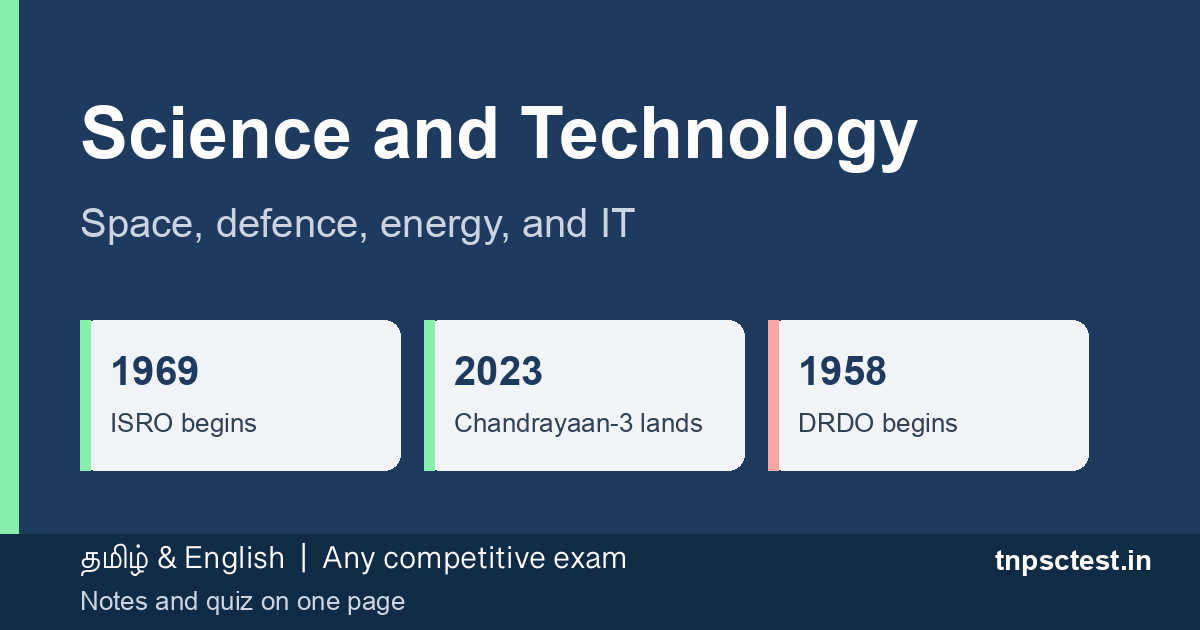
Science and Technology Notes: Space, Defence, Energy, and IT in Short Lines
Science and Technology notes for any competitive exam aspirant in India, on one page. Short lines. Tamil first, then English. The quiz is only in the Quiz section at the end of this page.
Table of Contents
- நினைவு
- விண்வெளித் திட்டம்
- செயற்கைக்கோள்களும் தொலையுணர்வும்
- பாதுகாப்பு ஆராய்ச்சி
- ஆற்றல்
- கணினியும் தகவல் தொழில்நுட்பமும்
- தகவல் தொடர்பு
- உயிரித் தொழில்நுட்பமும் மருத்துவமும்
- நானோவும் ரோபோவும்
- கடலும் எண்ணெயும்
- இந்திய அறிவியலாளர்கள்
- நிறுவனங்கள்
- Remember
- Space programme
- Satellites and remote sensing
- Defence research
- Energy
- Computers and IT
- Communication
- Biotechnology and medicine
- Nano and robots
- Ocean and oil
- Indian scientists
- Institutions
- Quiz
நினைவு
- இஸ்ரோ தொடங்கிய ஆண்டு 1969. ஏவுதளம் ஸ்ரீஹரிகோட்டா. முதல் இந்திய செயற்கைக்கோள் ஆர்யபட்டா, 1975.
- சந்திரயான்-3 2023 ஆகஸ்ட் 23 அன்று நிலவின் தென் துருவப் பகுதியில் இறங்கியது.
- செவ்வாய் ஆய்வுக்கலம் 2014 செப்டம்பர் 24 அன்று செவ்வாய் சுற்றுப்பாதையில் நிலைபெற்றது. முதல் முயற்சியிலேயே வென்ற நாடு இந்தியா.
- டிஆர்டிஓ தொடங்கிய ஆண்டு 1958. ஏவுகணை நாயகன் ஏ. பி. ஜே. அப்துல் கலாம்.
- இந்தியாவின் அணுத் திட்டத்தின் தந்தை ஹோமி பாபா. விண்வெளித் திட்டத்தின் தந்தை விக்ரம் சாராபாய்.
- தேசிய தொழில்நுட்ப நாள் மே 11. தேசிய அறிவியல் நாள் பிப்ரவரி 28. தேசிய விண்வெளி நாள் ஆகஸ்ட் 23.
- நானோ என்றால் 10⁻⁹ மீட்டர்.
- ஆர்யபட்டா செயற்கைக்கோளை இந்தியா சோவியத் ஒன்றிய ஏவுகலத்தில் ஏவியது. இந்தியாவின் சொந்த ஏவுகலத்தில் ஏவிய முதல் செயற்கைக்கோள் ரோகிணி, 1980.
விண்வெளித் திட்டம்
- 1962-இல் இந்திய விண்வெளி ஆராய்ச்சிக் குழு உருவானது. 1969-இல் இஸ்ரோ தொடங்கியது. தலைமையகம் பெங்களூரு.
- ஏவுதளம் ஆந்திராவின் ஸ்ரீஹரிகோட்டாவில் உள்ள சதீஷ் தவான் விண்வெளி மையம். தமிழ்நாட்டின் குலசேகரப்பட்டினத்தில் புதிய ஏவுதளம் திட்டமிடப்பட்டுள்ளது.
- எஸ்எல்வி-3 ஏவுகலம் 1980-இல் ரோகிணியை ஏவியது. இத்திட்டத்தின் இயக்குநர் அப்துல் கலாம்.
- பிஎஸ்எல்வி துருவச் சுற்றுப்பாதைக்கான ஏவுகலம். ஜிஎஸ்எல்வி புவிநிலைச் சுற்றுப்பாதைக்கான ஏவுகலம்.
- 2017-இல் பிஎஸ்எல்வி ஒரே பயணத்தில் 104 செயற்கைக்கோள்களை ஏவியது.
- சந்திரயான்-1 2008 அக்டோபர் மாதம் ஏவப்பட்டது. அது நிலவில் நீர்மூலக்கூறு இருப்பதற்கான சான்றை வழங்கியது.
- சந்திரயான்-3 2023 ஜூலை 14 அன்று ஏவப்பட்டது. நிலவில் மென்தரையிறக்கம் செய்த நான்காவது நாடு இந்தியா. தென் துருவப் பகுதியை அடைந்த முதல் நாடும் இந்தியா.
- மங்கள்யான் 2013 நவம்பர் 5 அன்று பிஎஸ்எல்வி-சி25 மூலம் ஏவப்பட்டது. செவ்வாயைச் சுற்றிய முதல் ஆசிய நாடு இந்தியா.
- ஆஸ்ட்ரோசாட் 2015 செப்டம்பர் 28 அன்று ஏவப்பட்டது. இது இந்தியாவின் முதல் வானியல் ஆய்வுச் செயற்கைக்கோள்.
- ஆதித்யா-எல்1 2023 செப்டம்பர் 2 அன்று ஏவப்பட்ட இந்தியாவின் முதல் சூரிய ஆய்வுக்கலம்.
செயற்கைக்கோள்களும் தொலையுணர்வும்
- இன்சாட் தொடர் தகவல் தொடர்புக்கானது. ஐஆர்எஸ் தொடர் தொலையுணர்வுக்கானது. முதல் ஐஆர்எஸ் 1988-இல் ஏவப்பட்டது.
- புவிநிலைச் செயற்கைக்கோள் நிலநடுக்கோட்டுக்கு மேல் சுமார் 36,000 கி.மீ உயரத்தில் உள்ளது. அதன் சுற்றுக்காலம் 24 மணி.
- தொலையுணர்வுச் செயற்கைக்கோள்கள் பெரும்பாலும் துருவச் சுற்றுப்பாதையில் சுமார் 700 முதல் 900 கி.மீ உயரத்தில் சுற்றும்.
- நாவிக் என்பது இந்தியாவின் சொந்த வழிகாட்டும் அமைப்பு. இது இந்தியாவையும் அதைச் சுற்றிய பகுதியையும் மட்டும் உள்ளடக்கும்.
- கார்ட்டோசாட் வரைபடப் பணிக்கானது. ரிசாட் ரேடார் படம் எடுக்கும். ஓசியன்சாட் கடல் ஆய்வுக்கானது.
- மேகம் இருந்தாலும் இரவிலும் ரேடார் படம் எடுக்க முடியும்.
- தேசிய தொலையுணர்வு மையம் ஹைதராபாத்தில் உள்ளது. புவன் என்பது இஸ்ரோவின் புவி இணையதளம்.
- புவித் தகவல் அமைப்பு என்பது வரைபடத் தரவுகளைக் கணினியில் ஆராயும் முறை.
பாதுகாப்பு ஆராய்ச்சி
- டிஆர்டிஓ பாதுகாப்பு அமைச்சின் கீழ் இயங்குகிறது. அதில் 50-க்கு மேற்பட்ட ஆய்வகங்கள் உள்ளன.
- 1983-இல் ஒருங்கிணைந்த ஏவுகணைத் திட்டம் தொடங்கியது. அதன் தலைவர் அப்துல் கலாம்.
- பிருத்வி தரையிலிருந்து தரைக்குப் பாயும். ஆகாஷ் தரையிலிருந்து வானுக்குப் பாயும். நாக் டாங்கி எதிர்ப்பு ஏவுகணை. அக்னி நெடுந்தொலைவு ஏவுகணை.
- பிரம்மோஸ் இந்தியாவும் ரஷ்யாவும் இணைந்து செய்த ஒலியை விட வேகமான ஏவுகணை.
- தேஜஸ் இலகு ரக போர் விமானம். அர்ஜுன் இந்தியாவின் சொந்த முதன்மைப் போர் டாங்கி.
- ஐஎன்எஸ் விக்ராந்த் இந்தியாவில் கட்டிய முதல் விமானம்தாங்கிக் கப்பல். அது 2022-இல் கடற்படையில் இணைக்கப்பட்டது.
- ஐஎன்எஸ் அரிஹந்த் இந்தியாவின் முதல் சொந்த அணுசக்தி நீர்மூழ்கிக் கப்பல்.
- இந்தியா 1974-இல் முதல் அணு சோதனையையும் 1998-இல் பொக்ரானில் சக்தி சோதனைகளையும் நடத்தியது.
- தக்ஷ் என்பது டிஆர்டிஓ உருவாக்கிய வெடிகுண்டு அகற்றும் ரோபோ.
ஆற்றல்
- வழக்கமான ஆற்றல்: நிலக்கரி, எண்ணெய், இயற்கை வாயு, நீர்மின்சாரம், அணுசக்தி. வழக்கமற்றது: சூரியன், காற்று, உயிர்ப்பொருள், அலை, புவிவெப்பம்.
- தேசிய சூரிய ஆற்றல் இயக்கம் 2010-இல் தொடங்கியது. பன்னாட்டுச் சூரிய ஆற்றல் கூட்டணி 2015-இல் இந்தியாவும் பிரான்சும் தொடங்கியது.
- குமரி மாவட்டத்தின் முப்பந்தல் இந்தியாவின் பெரிய காற்றாலைப் பகுதிகளில் ஒன்று. ராமநாதபுரம் மாவட்டத்தின் கமுதியில் பெரிய சூரிய மின் பூங்கா உள்ளது.
- அலை ஆற்றலுக்கு ஏற்ற இடங்கள் காம்பே வளைகுடாவும் கட்ச் வளைகுடாவும். புவிவெப்ப ஆற்றலுக்குப் புகா பள்ளத்தாக்கு.
- ஹோமி பாபா மூன்று நிலை அணுத் திட்டத்தை வகுத்தார். முதல் நிலை யுரேனியம். இரண்டாம் நிலை புளூட்டோனியம். மூன்றாம் நிலை தோரியம்.
- இந்தியாவில் தோரியம் மிகுதியாக உள்ளது. அது கேரளக் கடற்கரை மணலில் கிடைக்கும்.
- கல்பாக்கத்தில் வேக ஈனுலைத் திட்டம் உள்ளது.
- உயிர்வாயு மாட்டுச் சாணத்திலிருந்து கிடைக்கும். அதில் மீத்தேன் உள்ளது.
- பசுமை ஹைட்ரஜன் இயக்கம் 2023-இல் தொடங்கியது.
கணினியும் தகவல் தொழில்நுட்பமும்
- கணினித் தலைமுறைகள்: வெற்றிடக் குழாய், டிரான்சிஸ்டர், ஒருங்கிணைந்த சுற்று, நுண்செயலி, செயற்கை நுண்ணறிவு.
- ஒரு பைட் என்பது 8 பிட். ஒரு கிலோபைட் என்பது 1,024 பைட்.
- சூப்பர் கணினியின் திறன் ஃப்ளாப்ஸ் அளவில் அளக்கப்படும்.
- இந்தியாவின் பரம் சூப்பர் கணினிகளை புனேயில் உள்ள சி-டாக் உருவாக்கியது. பிரத்யூஷ் என்பது புனேயில் உள்ள வானிலை சூப்பர் கணினி.
- இணையத்தை 1969-இல் அர்ப்பாநெட் தொடங்கியது. உலகளாவிய வலையை 1989-இல் டிம் பெர்னர்ஸ்-லீ உருவாக்கினார்.
- இந்தியாவில் பொது இணையச் சேவை 1995 ஆகஸ்ட் 15 அன்று விஎஸ்என்எல் மூலம் தொடங்கியது.
- தகவல் தொழில்நுட்பச் சட்டம் 2000. அதன் கீழ் இணையக் குற்றங்கள் கையாளப்படும்.
- டிஜிட்டல் இந்தியா திட்டம் 2015 ஜூலை 1 அன்று தொடங்கியது. யுபிஐ முறை 2016-இல் என்பிசிஐ மூலம் அறிமுகமானது.
- ஆதார் எண்ணை வழங்கும் அமைப்பு யுஐடிஏஐ. அது 2009-இல் தொடங்கியது.
- செயற்கை நுண்ணறிவு என்ற சொல்லை 1956-இல் ஜான் மெக்கார்த்தி தந்தார்.
தகவல் தொடர்பு
- தொலைபேசியை 1876-இல் கிரஹாம் பெல் கண்டார். வானொலி அலையை ஹெர்ட்ஸ் கண்டறிந்தார்.
- முதல் தலைமுறை அனலாக். இரண்டாம் தலைமுறை டிஜிட்டல், ஜிஎஸ்எம் அதில் ஒன்று. மூன்றாம் தலைமுறையில் இணையச் சேவை தொடங்கியது. நான்காம் தலைமுறை எல்டிஇ.
- இந்தியாவில் 5ஜி சேவை 2022 அக்டோபர் 1 அன்று தொடங்கியது.
- ஒளியிழை முழு அக உட்பிரதிபலிப்பு மூலம் ஒளியைக் கடத்தும். அதில் தகவல் மிக வேகமாகச் செல்லும்.
- புளூடூத் குறுந்தொலைவு வயர்லெஸ் தொடர்பு. வைஃபை உள்ளூர் வலையமைப்பு.
- தொலைத்தொடர்பு ஒழுங்காற்று ஆணையம் ட்ராய் என அழைக்கப்படும். அது 1997-இல் உருவானது.
- பாரத்நெட் திட்டம் கிராமங்களுக்கு ஒளியிழை இணைப்பைத் தர உருவானது.
உயிரித் தொழில்நுட்பமும் மருத்துவமும்
- மறுசேர்க்கை டிஎன்ஏ முறையை 1973-இல் கோஹனும் போயரும் உருவாக்கினர்.
- மனித இன்சுலின் முதல் மரபணுப் பொறியியல் மருந்து. கரு மூலம் உருவான டாலி ஆடு 1996-இல் உருவாக்கப்பட்டது.
- இந்தியாவில் வணிகப் பயன்பாட்டுக்கு அனுமதி பெற்ற ஒரே மரபணு மாற்றப் பயிர் பிடி பருத்தி. அது 2002-இல் அனுமதி பெற்றது.
- மரபணு மாற்றப் பயிர்களை மரபணுப் பொறியியல் மதிப்பீட்டுக் குழு கண்காணிக்கும்.
- மனித மரபணுத் திட்டம் 2003-இல் நிறைவுற்றது. டிஎன்ஏ விரல்ரேகையை 1984-இல் அலெக் ஜெஃப்ரிஸ் உருவாக்கினார்.
- சிஆர்ஐஎஸ்பிஆர் மரபணுத் திருத்த முறைக்கு 2020-இல் நோபல் பரிசு வழங்கப்பட்டது.
- இந்தியாவின் முதல் சோதனைக் குழாய்க் குழந்தை துர்கா. அவள் 1978 அக்டோபர் 3 அன்று கொல்கத்தாவில் பிறந்தாள்.
- உலகின் முதல் இதய மாற்று அறுவையை 1967-இல் கிறிஸ்டியன் பர்னார்டு செய்தார். இந்தியாவின் முதல் இதய மாற்று 1994-இல் நடைபெற்றது.
- மனித உறுப்பு மாற்றுச் சட்டம் 1994-இல் இயற்றப்பட்டது.
- கோவாக்சின் இந்தியாவில் உருவான கொரோனா தடுப்பூசி. கோவிஷீல்டின் தயாரிப்பு நிறுவனம் சீரம். இந்தியாவில் தடுப்பூசி 2021 ஜனவரி 16 அன்று தொடங்கியது.
- ஆயுஷ்மான் பாரத் திட்டம் 2018-இல் தொடங்கியது.
நானோவும் ரோபோவும்
- நானோ என்பது 10⁻⁹ மீட்டர். ஒரு நானோ மீட்டர் என்பது 0.000000001 மீட்டர்.
- நானோ தொழில்நுட்பத்தைப் பற்றிய கருத்தை 1959-இல் ரிச்சர்டு ஃபெய்ன்மேன் தந்தார். இந்தியாவில் நானோ இயக்கம் 2007-இல் தொடங்கியது.
- கார்பன் நானோ குழாய் மிக வலிமையானது. கிராஃபீன் ஒரு அணு தடிமனுள்ள கார்பன் தகடு.
- நானோ தொழில்நுட்பம் மருந்தைச் சரியான இடத்துக்குக் கொண்டுசெல்லப் பயன்படுகிறது. தானே தூய்மையாகும் கண்ணாடியிலும் பயன்படுகிறது.
- ரோபோ என்ற சொல் 1920-இல் செக் எழுத்தாளர் கரேல் சாப்பெக் நாடகத்தில் இடம்பெற்றது. ரோபாட்டிக்ஸ் என்ற சொல்லை ஐசக் அசிமோவ் தந்தார்.
- முதல் நிரல் இயக்க ரோபோ யூனிமேட். அது 1961-இல் தொழிற்சாலையில் நிறுவப்பட்டது.
- செவ்வாயில் இறங்கிய ரோவர்கள்: சோஜர்னர், கியூரியாசிட்டி, பெர்சிவரன்ஸ்.
- அலன் டூரிங் 1950-இல் டூரிங் சோதனையை முன்வைத்தார்.
கடலும் எண்ணெயும்
- ஐநா கடல் சட்ட உடன்படிக்கை 1982-இல் ஏற்கப்பட்டது. கடற்கரையிலிருந்து 200 கடல் மைல் வரை தனிப்பொருளாதார மண்டலம்.
- இந்தியாவின் தனிப்பொருளாதார மண்டலம் சுமார் 20 இலட்சம் ச.கி.மீ.
- தேசியக் கடல் தொழில்நுட்ப நிறுவனம் சென்னையில் உள்ளது. இந்திய கடல் தகவல் மையம் ஹைதராபாத்தில் உள்ளது. அது சுனாமி எச்சரிக்கை தரும்.
- கடல் மேம்பாட்டுத் துறை 1981-இல் தொடங்கியது. ஆழ்கடல் இயக்கம் 2021-இல் தொடங்கியது.
- இந்தியாவின் அண்டார்டிகா நிலையங்கள்: தட்சிண் கங்கோத்ரி, மைத்ரி, பாரதி. ஆர்க்டிக் நிலையம் இமாத்ரி.
- ஓஎன்ஜிசி 1956-இல் தொடங்கியது. தேராடூனில் உள்ளது.
- இந்தியாவின் முதல் எண்ணெய்க் கிணறு அசாமின் திக்பாய். மும்பை ஹை கடலுக்குள் உள்ள எண்ணெய் வயல், 1974-இல் கண்டறியப்பட்டது.
- காவிரிப் படுகையில் தமிழ்நாட்டின் எண்ணெய் மற்றும் எரிவாயு வயல்கள் உள்ளன.
- கிருஷ்ணா கோதாவரிப் படுகையில் இயற்கை வாயு உள்ளது.
- ஆயில் இந்தியா நிறுவனம் 1959-இல் தொடங்கியது.
இந்திய அறிவியலாளர்கள்
- சி. வி. ராமன் 1928 பிப்ரவரி 28 அன்று ராமன் விளைவைக் கண்டார். 1930-இல் இயற்பியல் நோபல் பரிசு பெற்றார்.
- சுப்பிரமணியன் சந்திரசேகர் 1983-இல் இயற்பியல் நோபல் பெற்றார். அவர் லாகூரில் பிறந்தவர். தமிழ்நாட்டைச் சேர்ந்த குடும்பம் அவருடையது. 1.44 சூரிய நிறை என்பது சந்திரசேகர் எல்லை.
- ஹர் கோவிந்த் குரானா 1968-இல் மருத்துவ நோபல் பெற்றார். வெங்கட்ராமன் ராமகிருஷ்ணன் 2009-இல் வேதியியல் நோபல் பெற்றார்.
- சத்யேந்திரநாத் போஸ் போஸான் துகள் கருத்துக்கு உரியவர். மேக்நாத் சாஹா வெப்ப அயனியாக்கச் சமன்பாட்டைத் தந்தார்.
- சீனிவாச ராமானுஜன் 1887-இல் ஈரோட்டில் பிறந்தார். அவர் பிறந்த நாளான டிசம்பர் 22 தேசியக் கணித நாள்.
- ஜி. டி. நாயுடு கோவையைச் சேர்ந்த கண்டுபிடிப்பாளர். அவர் இந்தியாவின் எடிசன் என அழைக்கப்படுகிறார்.
- எம். எஸ். சுவாமிநாதன் இந்தியப் பசுமைப் புரட்சியின் தந்தை. வர்கீஸ் குரியன் வெண்மைப் புரட்சியின் தந்தை.
- சலீம் அலி இந்தியாவின் பறவை மனிதர். விஸ்வேஸ்வரய்யா பிறந்த நாளான செப்டம்பர் 15 பொறியாளர் நாள்.
நிறுவனங்கள்
- சிஎஸ்ஐஆர் 1942-இல் தொடங்கியது. அணுசக்தித் துறை 1954-இல் தொடங்கியது. பாபா அணு ஆராய்ச்சி மையம் 1957-இல் மும்பையில் உருவானது.
- டிஆர்டிஓ 1958. இஸ்ரோ 1969. அறிவியல் தொழில்நுட்பத் துறை 1971. உயிரித் தொழில்நுட்பத் துறை 1986.
- இந்திய அறிவியல் கழகம் 1909-இல் பெங்களூருவில் தொடங்கியது. சென்னை ஐஐடி 1959-இல் தொடங்கியது.
- இந்திய மருத்துவ ஆராய்ச்சிக் கழகம் 1911-இல் தொடங்கியது. இந்திய வேளாண் ஆராய்ச்சிக் கழகம் 1929-இல் தொடங்கியது.
- மத்திய மின்வேதியியல் ஆராய்ச்சி நிலையம் காரைக்குடியில் உள்ளது. மத்திய தோல் ஆராய்ச்சி நிலையம் சென்னையில் உள்ளது.
- கல்பாக்கத்தில் இந்திரா காந்தி அணு ஆராய்ச்சி மையம் உள்ளது.
Remember
- ISRO began in 1969. The launch site is Sriharikota. India’s first satellite was Aryabhata, 1975.
- Chandrayaan-3 landed near the Moon’s south pole on 23 August 2023.
- The Mars orbiter reached Mars orbit on 24 September 2014. India is the first country to succeed on the first try.
- DRDO began in 1958. The Missile Man is A. P. J. Abdul Kalam.
- The father of India’s atomic programme is Homi Bhabha. The father of the space programme is Vikram Sarabhai.
- National Technology Day is 11 May. National Science Day is 28 February. National Space Day is 23 August.
- Nano means 10⁻⁹ metre.
- India launched Aryabhata on a Soviet rocket. The first satellite launched on India’s own rocket was Rohini in 1980.
Space programme
- The space research committee began in 1962. ISRO began in 1969. The headquarters is Bengaluru.
- The launch site is the Satish Dhawan Space Centre at Sriharikota in Andhra Pradesh. A new launch site is planned at Kulasekarapattinam in Tamil Nadu.
- The SLV-3 rocket launched Rohini in 1980. Abdul Kalam directed that project.
- The PSLV is the rocket for polar orbits. The GSLV is the rocket for geostationary orbits.
- In 2017 a PSLV put 104 satellites in orbit on one flight.
- Chandrayaan-1 was launched in October 2008. It gave evidence of water molecules on the Moon.
- Chandrayaan-3 was launched on 14 July 2023. India is the fourth country to soft-land on the Moon. It is the first to reach the south polar region.
- Mangalyaan was launched on 5 November 2013 by PSLV-C25. India is the first Asian country to orbit Mars.
- AstroSat was launched on 28 September 2015. It is India’s first astronomy satellite.
- Aditya-L1 was launched on 2 September 2023. It is India’s first solar mission.
Satellites and remote sensing
- The INSAT series is for communication. The IRS series is for remote sensing. The first IRS was launched in 1988.
- A geostationary satellite is about 36,000 km above the equator. Its period is 24 hours.
- Remote sensing satellites mostly circle in a polar orbit about 700 to 900 km up.
- NavIC is India’s own navigation system. It covers India and the region around it.
- Cartosat is for mapping. RISAT takes radar images. Oceansat is for ocean study.
- Radar can take pictures through cloud and at night.
- The National Remote Sensing Centre is in Hyderabad. Bhuvan is ISRO’s geo portal.
- A geographic information system studies map data on a computer.
Defence research
- DRDO works under the Ministry of Defence. It has more than 50 laboratories.
- The Integrated Guided Missile Development Programme began in 1983. Abdul Kalam led it.
- Prithvi is surface to surface. Akash is surface to air. Nag is an anti-tank missile. Agni is a long range missile.
- BrahMos is a supersonic cruise missile made by India and Russia together.
- Tejas is a light combat aircraft. Arjun is India’s own main battle tank.
- INS Vikrant is the first aircraft carrier built in India. It joined the navy in 2022.
- INS Arihant is India’s first indigenous nuclear powered submarine.
- India held its first nuclear test in 1974. The Shakti tests were at Pokhran in 1998.
- Daksh is a bomb disposal robot made by DRDO.
Energy
- Conventional energy: coal, oil, natural gas, hydro, and nuclear. Non-conventional: sun, wind, biomass, tide, and earth heat.
- The National Solar Mission began in 2010. India and France began the International Solar Alliance in 2015.
- Muppandal in Kanyakumari district is among India’s largest wind farm areas. Kamuthi in Ramanathapuram district has a large solar park.
- Good places for tidal power are the Gulf of Khambhat and the Gulf of Kutch. Puga Valley is the place for geothermal power.
- Homi Bhabha planned a three stage nuclear programme. Stage one uses uranium. Stage two uses plutonium. Stage three uses thorium.
- India has plenty of thorium. It lies in the beach sand of Kerala.
- Kalpakkam has the fast breeder reactor project.
- Biogas comes from cow dung. It holds methane.
- The Green Hydrogen Mission began in 2023.
Computers and IT
- Computer generations: vacuum tube, transistor, integrated circuit, microprocessor, and artificial intelligence.
- One byte is 8 bits. One kilobyte is 1,024 bytes.
- A supercomputer’s speed is measured in flops.
- The PARAM supercomputers were made by C-DAC in Pune. Pratyush is a weather supercomputer in Pune.
- ARPANET began the internet in 1969. Tim Berners-Lee created the World Wide Web in 1989.
- Public internet service began in India on 15 August 1995 through VSNL.
- The Information Technology Act came in 2000. Cyber crime is handled under it.
- Digital India began on 1 July 2015. NPCI brought in UPI in 2016.
- The body that issues Aadhaar is UIDAI. It began in 2009.
- John McCarthy gave the term artificial intelligence in 1956.
Communication
- Graham Bell invented the telephone in 1876. Hertz found radio waves.
- First generation mobile was analogue. Second generation was digital, and GSM is one kind. Third generation brought the internet. Fourth generation is LTE.
- 5G service began in India on 1 October 2022.
- Optical fibre carries light by total internal reflection. Data moves very fast in it.
- Bluetooth is short range wireless. Wi-Fi is a local network.
- The telecom regulator is TRAI. It was set up in 1997.
- The BharatNet project brings fibre to villages.
Biotechnology and medicine
- Cohen and Boyer made recombinant DNA in 1973.
- Human insulin was the first genetically engineered medicine. Dolly the sheep, a clone, was born in 1996.
- Bt cotton is the only genetically modified crop allowed for commercial use in India. It was approved in 2002.
- The Genetic Engineering Appraisal Committee watches over modified crops.
- The Human Genome Project ended in 2003. Alec Jeffreys developed DNA fingerprinting in 1984.
- The CRISPR gene editing method won the Nobel Prize in 2020.
- India’s first test tube baby was Durga. She was born in Kolkata on 3 October 1978.
- Christiaan Barnard did the first heart transplant in 1967. India’s first heart transplant was in 1994.
- The Transplantation of Human Organs Act came in 1994.
- Covaxin is the Covid vaccine developed in India. The Serum Institute made Covishield. India began vaccination on 16 January 2021.
- Ayushman Bharat began in 2018.
Nano and robots
- Nano means 10⁻⁹ metre. One nanometre is 0.000000001 metre.
- Richard Feynman gave the idea of nanotechnology in 1959. India’s Nano Mission began in 2007.
- A carbon nanotube is very strong. Graphene is a sheet of carbon one atom thick.
- Nanotechnology is used to carry medicine to the right spot. It is also used in self-cleaning glass.
- The word robot came from a 1920 play by the Czech writer Karel Capek. Isaac Asimov gave the word robotics.
- The first programmable robot was Unimate. It was fitted in a factory in 1961.
- The rovers that landed on Mars are Sojourner, Curiosity, and Perseverance.
- Alan Turing proposed the Turing test in 1950.
Ocean and oil
- The UN Convention on the Law of the Sea was adopted in 1982. The Exclusive Economic Zone runs 200 nautical miles from the coast.
- India’s Exclusive Economic Zone is about 2 million sq km.
- The National Institute of Ocean Technology is in Chennai. INCOIS in Hyderabad gives tsunami warnings.
- The Department of Ocean Development began in 1981. The Deep Ocean Mission began in 2021.
- India’s Antarctic stations are Dakshin Gangotri, Maitri, and Bharati. The Arctic station is Himadri.
- ONGC began in 1956. It is in Dehradun.
- India’s first oil well was at Digboi in Assam. Mumbai High is an offshore oil field found in 1974.
- The Cauvery basin holds oil and gas fields in Tamil Nadu.
- The Krishna Godavari basin holds natural gas.
- Oil India Limited began in 1959.
Indian scientists
- C. V. Raman found the Raman effect on 28 February 1928. He won the Nobel Prize in Physics in 1930.
- Subrahmanyan Chandrasekhar won the Nobel Prize in Physics in 1983. He was born in Lahore. His family was from Tamil Nadu. The Chandrasekhar limit is 1.44 solar masses.
- Har Gobind Khorana won the Nobel Prize in Medicine in 1968. Venkatraman Ramakrishnan won the Nobel Prize in Chemistry in 2009.
- Satyendra Nath Bose is linked with the boson. Meghnad Saha gave the thermal ionisation equation.
- Srinivasa Ramanujan was born in Erode in 1887. His birthday, 22 December, is National Mathematics Day.
- G. D. Naidu of Coimbatore was an inventor. He is called the Edison of India.
- M. S. Swaminathan is the father of India’s Green Revolution. Verghese Kurien is the father of the White Revolution.
- Salim Ali is the Birdman of India. Engineers Day, 15 September, marks the birthday of Visvesvaraya.
Institutions
- CSIR began in 1942. The Department of Atomic Energy began in 1954. The Bhabha Atomic Research Centre was set up in Mumbai in 1957.
- DRDO 1958. ISRO 1969. Department of Science and Technology 1971. Department of Biotechnology 1986.
- The Indian Institute of Science began in Bengaluru in 1909. IIT Madras began in 1959.
- The Indian Council of Medical Research began in 1911. The Indian Council of Agricultural Research began in 1929.
- The Central Electrochemical Research Institute is in Karaikudi. The Central Leather Research Institute is in Chennai.
- The Indira Gandhi Centre for Atomic Research is at Kalpakkam.
Quiz
Science and Technology pool
Ten questions
The first 10 are ready. Pull another 10 from the Science and Technology pool. Switch to Tamil for the Tamil set.
1. Chandrayaan-3 soft-landed near the Moon's south pole on which date?
A) 23 August 2023B) 14 July 2023C) 22 October 2008D) 2 September 20232. India's first satellite, Aryabhata, was launched in:
A) 1969B) 1980C) 1975D) 19633. The Mars Orbiter Mission reached Mars orbit on:
A) 5 November 2013B) 24 September 2014C) 28 September 2015D) 23 August 20234. DRDO was established in which year?
A) 1942B) 1954C) 1969D) 19585. BrahMos is a supersonic cruise missile developed jointly by India and:
A) RussiaB) FranceC) IsraelD) the United States6. The third stage of India's nuclear power programme is based on which fuel?
A) UraniumB) ThoriumC) PlutoniumD) Radium7. Muppandal in Kanyakumari district is best known for:
A) A solar parkB) A thermal stationC) Wind farmsD) A nuclear plant8. India's first test tube baby, Durga, was born in:
A) 1969B) 1984C) 1991D) 19789. The Exclusive Economic Zone under UNCLOS extends how far from the coast?
A) 200 nautical milesB) 12 nautical milesC) 24 nautical milesD) 350 nautical miles10. The Digital India programme was launched in:
A) 2000B) 2010C) 2015D) 2022
Answers and explanations
This set practises Science and Technology. Take the test, then open each explanation.
Question 1
Chandrayaan-3 soft-landed near the Moon's south pole on which date?
Answer: A. Chandrayaan-3 landed on 23 August 2023, now marked as National Space Day. It was launched on 14 July. 2 September 2023 is the Aditya-L1 launch.
Question 2
India's first satellite, Aryabhata, was launched in:
Answer: C. Aryabhata went up in 1975 on a Soviet rocket. The first satellite on India's own rocket was Rohini in 1980. ISRO itself began in 1969.
Question 3
The Mars Orbiter Mission reached Mars orbit on:
Answer: B. The orbiter was launched on 5 November 2013 and reached Mars orbit on 24 September 2014. India is the first country to succeed on the first try.
Question 4
DRDO was established in which year?
Answer: D. DRDO began in 1958 under the Ministry of Defence. CSIR started in 1942, the Department of Atomic Energy in 1954, and ISRO in 1969.
Question 5
BrahMos is a supersonic cruise missile developed jointly by India and:
Answer: A. BrahMos is made by India and Russia together. Its name comes from the Brahmaputra and the Moskva rivers.
Question 6
The third stage of India's nuclear power programme is based on which fuel?
Answer: B. Homi Bhabha planned three stages. Stage one uses uranium, stage two plutonium, and stage three thorium, which India has in plenty in coastal sand.
Question 7
Muppandal in Kanyakumari district is best known for:
Answer: C. Muppandal is among India's largest wind farm areas. The large solar park is at Kamuthi in Ramanathapuram district.
Question 8
India's first test tube baby, Durga, was born in:
Answer: D. Durga was born in Kolkata on 3 October 1978, not long after the world's first test tube baby in Britain.
Question 9
The Exclusive Economic Zone under UNCLOS extends how far from the coast?
Answer: A. The UN Convention on the Law of the Sea, adopted in 1982, gives a coastal state an EEZ of 200 nautical miles. The territorial sea is 12.
Question 10
The Digital India programme was launched in:
Answer: C. Digital India began on 1 July 2015. The IT Act came in 2000, and 5G services were launched in October 2022.
Get study tips, mock tests, and exam notifications delivered free.